The Post-Trade Show Playbook: Day 1 to Day 30
· 11 min read
The trade show is over. Your team is packing up the booth, sorting through business cards, and comparing lead counts. The event felt productive — dozens of conversations, genuine interest, a few handshakes that felt like real opportunities.
Now what?
This is where most exhibitors lose. Not because they didn’t generate leads, but because they don’t have a structured plan for the 30 days that follow. The leads sit in a spreadsheet. The follow-ups trickle out over weeks. By the time most emails land, the prospect has forgotten the conversation — and chosen the competitor who moved faster.
80%
of trade show leads are never followed up effectively
CEIR — Center for Exhibition Industry Research
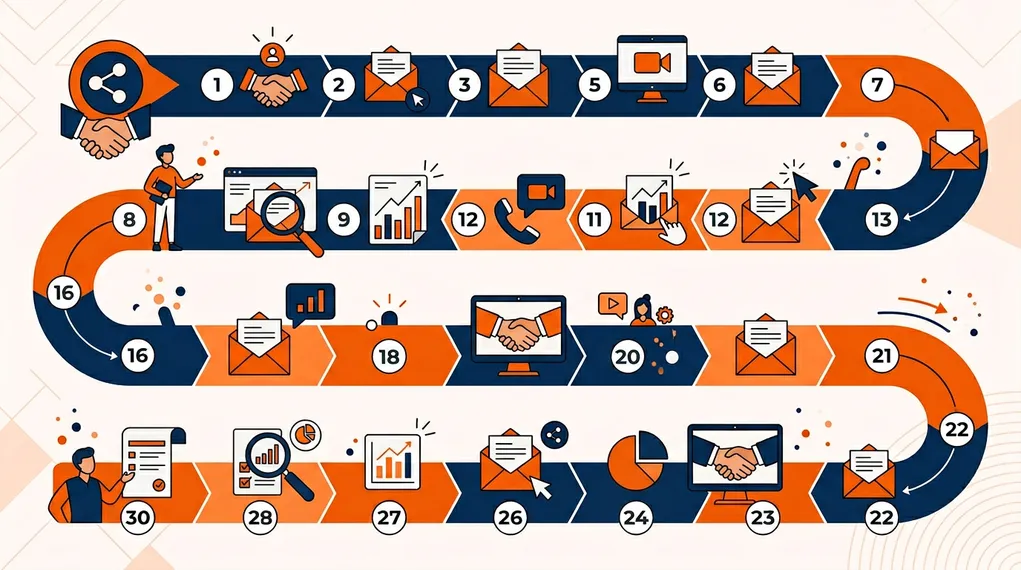
This playbook gives you a day-by-day framework for converting trade show leads into pipeline. It’s the same structure used by teams that consistently convert 3–5× more leads than industry average — not because they have bigger booths, but because they have a system for what happens after the lights go off.
Day 0: At the Event
The most important follow-up work happens before you leave the venue. Day zero is not about relaxing after a long show day — it’s about capturing context while it’s fresh and sending first-touch emails while prospects still remember your face.
Capture Everything in Real Time
Every conversation should be captured immediately — not batched at the end of the day. Scan the badge or business card, record a voice note with the conversation context, and let AI generate a personalized follow-up. The entire process takes under two minutes per lead. For a detailed walkthrough of this workflow, see our guide on how to follow up in under two minutes.
The teams that win at events don’t wait until the hotel room to write follow-ups. They send them from the booth, between conversations, during coffee breaks. By the time the show floor closes, their hottest leads have already received a personalized email.
Send First Follow-Ups Same-Day
The speed-to-lead research is unambiguous: leads contacted within five minutes convert 21× better than those contacted after 30 minutes. At trade shows, the window is even more compressed because prospects are talking to your competitors in adjacent booths.
Same-day follow-up isn’t a nice-to-have. It’s the single highest-leverage activity in your entire event investment.
Day 1: Team Debrief and Lead Triage
The morning after the event — or the first business day back — is for alignment. Before anyone starts calling leads, the team needs a shared picture of what happened.
Run a 30-Minute Debrief
Gather every team member who worked the booth. Review the numbers: total leads captured, follow-ups already sent, conversations flagged as high-priority. Identify patterns: which messaging resonated, which product features generated the most questions, which competitor came up most often.
This isn’t a post-mortem. It’s a forward-looking session. The goal is to identify the top 20% of leads that deserve immediate, high-touch attention — and agree on who owns each one.
Score and Prioritize
Not all leads are equal. A VP who spent 15 minutes discussing a specific pain point is not the same as a passerby who grabbed a brochure. On day one, categorize every lead by warmth: hot (immediate opportunity), warm (genuine interest, longer timeline), and cold (informational, no clear fit). For a deeper framework on how to do this systematically, see our guide on trade show lead scoring.
Your hot leads should already have same-day follow-ups from the event floor. Day one is about making sure nothing fell through the cracks and that warm leads get their first touch within 48 hours. Automatic email enrichment ensures you have verified contact data even when the business card was incomplete.
Days 2–3: Personalized Follow-Ups for Hot and Warm Leads
Day 0 — Capture and send from the floor
Scan every badge, record voice context, send AI-personalized follow-ups in real time. Target: 100% of hot leads emailed same-day.
Day 1 — Debrief, score, and assign
30-minute team debrief. Categorize leads as hot/warm/cold. Assign ownership. Verify all hot leads have first-touch emails.
Days 2–3 — Personalized outreach to warm leads
Every warm lead gets a personalized email referencing the specific conversation. Include a clear next step: demo link, calendar invite, or resource.
Days 4–7 — First wave complete, track responses
Monitor open rates and reply rates. Follow up on replies immediately. Flag non-responders for wave two.
Week 2 — Second touch for non-responders
New angle, new value. Don't just 'bump' the thread. Reference something specific from the event or share a relevant resource.
Weeks 3–4 — Nurture sequence and CRM workflow
Move remaining leads into your standard nurture sequence. Ensure CRM data is complete for long-term pipeline management.
By end of day three, every hot and warm lead should have received a personalized email. Not a template. Not a “Great meeting you at [Event Name]” mass blast. A message that references what you discussed, the problem they described, and a specific next step.
If you used NeverDrop’s capture and follow-up workflow at the event, your hot leads already have AI-drafted emails sent from the booth. Days 2–3 are for the warm leads that needed a bit more thought — the ones where the conversation was promising but the next step wasn’t obvious.
The Follow-Up Email That Works
The best post-trade show emails share three characteristics:
Specific context: “You mentioned your team struggles with X — here’s how we’ve helped similar companies solve it.” This only works if you captured the conversation context in real time.
A clear next step: Not “let’s connect sometime” but “I’ve blocked 15 minutes on Tuesday at 2pm — does that work for a quick call?” A calendar link removes friction.
Brevity: Three to five sentences. The prospect doesn’t want to read an essay. They want to know you listened and that you have a clear proposal. For templates and examples, check our trade show follow-up email templates. And to understand why AI-drafted emails outperform templates, see our deep dive on context-based personalization.
Days 4–7: First Wave Complete
By the end of week one, your first wave of follow-ups should be done. Every lead — hot, warm, and cold — should have received at least one personalized touch.
Now the data starts coming in. Track three metrics:
Open rate: Are your subject lines working? Industry average for post-event emails is around 30%. If you’re significantly below, your subject lines or sender reputation need work.
Reply rate: This is the metric that matters. A reply — even a “not right now” — is engagement. Hot leads followed up within five minutes typically see 30–45% reply rates. Leads followed up after a week drop to 5–10%.
Meeting booked rate: The ultimate conversion. How many follow-ups turned into scheduled calls or demos? This is where the pipeline starts.
Respond to every reply within the hour. If a prospect took the time to respond to your follow-up, they’re signaling interest. Don’t let that signal decay.
Week 2: Second Touch for Non-Responders
Half of your leads won’t respond to the first email. That’s normal. It doesn’t mean they’re not interested — it means they’re busy, the email got buried, or the timing wasn’t right.
The second touch is not a “just bumping this to the top of your inbox” email. That’s lazy and it signals that you have nothing new to offer.
"The fortune is in the follow-up. 80% of deals require at least five touchpoints — but most salespeople give up after one or two."
— Brevet Group, Sales Research, National Sales Executive Association data
Instead, the second touch should add new value:
- Share a relevant case study or industry insight from the event
- Reference a news item about their company or industry
- Offer a different format: “I recorded a 2-minute video walkthrough of how this would work for your team”
- Ask a question that invites a low-friction response: “Is [specific pain point] still a priority for Q3?”
The goal isn’t to repeat yourself. It’s to give the prospect a new reason to engage.
Weeks 3–4: Nurture and CRM Workflow
By week three, the initial urgency of the event has faded. The leads that were going to convert quickly have already responded. What remains is the long tail — prospects who are interested but not ready, who need nurturing over weeks or months.
Transition to Your Standard Nurture Sequence
Move cold and unresponsive warm leads into your marketing automation or nurture sequence. This isn’t abandoning them — it’s putting them into a system designed for longer buying cycles.
The critical step here is making sure the CRM data is clean and complete. If you’ve been using an event lead capture workflow that syncs to HubSpot or your CRM, the contact record should already have the conversation transcript, follow-up emails, event details, and lead score. If you did this manually, week three is the deadline to get everything into the CRM.
Review and Report
At the end of 30 days, run the numbers:
- Total leads captured at the event
- Follow-ups sent within 24 hours (%)
- Reply rate by lead temperature (hot / warm / cold)
- Meetings booked
- Pipeline created (deals opened)
- Estimated pipeline value
This report serves two purposes. First, it quantifies the ROI of the event — which is essential for justifying next year’s budget. Second, it identifies what worked and what didn’t in your follow-up process so you can improve for the next show. AI-powered lead reports can accelerate this analysis by scoring ICP fit and surfacing buying signals from conversations. For a comprehensive pre-event framework, see our trade show preparation checklist.
The Compounding Effect of Speed
The entire playbook rests on one principle: speed compounds. A same-day follow-up doesn’t just improve the response rate on that email — it improves every subsequent interaction. The prospect remembers you. Your name is anchored. The relationship has momentum.
35–50%
of sales go to the first vendor who responds
InsideSales.com / Lead Response Management Study
Conversely, delay compounds negatively. A late first touch means a colder second touch, a lower reply rate, and a longer sales cycle. By week three, you’re effectively cold-emailing someone you already paid to meet in person.
The playbook is simple. The discipline is hard. But the teams that follow it — systematically, every event, every lead — are the ones who turn trade shows from cost centers into pipeline machines.
The 30-Day Checklist
Here’s the compressed version you can pin to your team’s Slack channel:
- Day 0: Capture every lead in real time. Send AI-personalized follow-ups from the floor.
- Day 1: Team debrief. Score leads (hot/warm/cold). Assign ownership.
- Days 2–3: Personalized emails to all warm leads. Clear next step in every message.
- Days 4–7: Track opens, replies, meetings. Respond to every reply within the hour.
- Week 2: Second touch for non-responders. New value, new angle.
- Weeks 3–4: Transition to nurture sequence. Complete CRM data. Run 30-day report.
The difference between an exhibitor who converts 5% of their leads and one who converts 25% isn’t the booth, the product, or the pitch. It’s the 30 days that follow.
Frequently Asked Questions
Send your first personalized follow-up the same day — ideally within minutes of the conversation. Research shows leads contacted within 5 minutes convert 21× better. Day 1 should be reserved for team debrief and lead scoring, not first outreach.
A proven 5-touch sequence: Day 0 — personalized email referencing the conversation; Day 2-3 — value-add follow-up with relevant content; Day 7 — check-in with meeting request; Day 14 — case study or social proof; Day 21 — final touch or nurture assignment.
Use a combination of conversation quality (captured via voice notes), ICP fit (assessed by AI scoring), and buying signals (timeline, budget mentions, specific pain points). Hot leads get same-day calls; warm leads get the full email sequence; cold leads enter nurture.
Immediately — preferably automatically. Manual CSV imports days after the event lose context and create duplicates. Tools like NeverDrop sync contacts, conversation context, and follow-up emails to HubSpot in real-time as you capture leads.
Turn your next trade show into a pipeline machine. Capture leads, send personalized follow-ups in under 2 minutes, and never lose a lead again.
Get Started Free