How to Follow Up After a Trade Show in Under 2 Minutes
· 7 min read
You just had a great conversation at your booth. The prospect is interested, you exchanged cards, you shook hands. Now what?
If the answer is “add them to the spreadsheet and follow up next week,” you’ve already lost. Research from Lead Connect shows that responding within five minutes of first contact makes you 21 times more likely to qualify the lead. After 30 minutes, the odds drop by a factor of 10. After 24 hours, you’re competing with every other vendor who also scanned that badge.
The traditional post-event follow-up takes two to five business days. By then, the prospect has spoken with 40 other exhibitors, attended a dozen sessions, and can barely remember which booth was yours.
21×
higher conversion rate when you follow up within 5 minutes
Lead Connect / InsideSales.com — Speed-to-Lead Research
The math is clear. Speed wins. The question is how to be fast without being generic.
Why Post-Event Follow-Up Is Broken
The standard workflow looks like this: collect leads all day, fly home, export a CSV, segment the list, write templates, personalize (sort of), and send. By the time the email lands in the prospect’s inbox, they’ve mentally moved on.
This isn’t a discipline problem. It’s a systems problem. The tools most teams use are designed for batch processing, not real-time engagement. Badge scanners capture data but not context. CRM imports happen in bulk. Follow-up templates are written for segments, not individuals.
The result? 80% of trade show leads never receive any follow-up at all. Not because salespeople are lazy — because the workflow makes speed structurally impossible.
The 2-Minute Follow-Up Workflow
What if you could send a personalized follow-up email while still standing at the booth — before the next prospect walks up? Here’s the workflow that makes it possible.
Scan the badge or business card
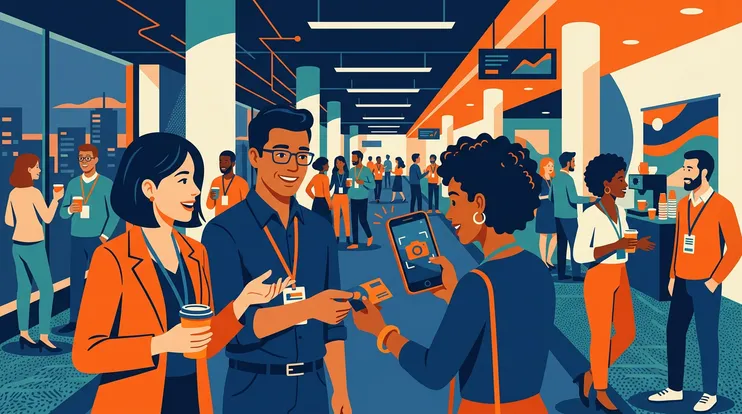
Use your phone camera to capture the prospect's contact information. OCR extracts name, company, title, email, and phone number automatically. No typing required.
Record a 30-second voice note
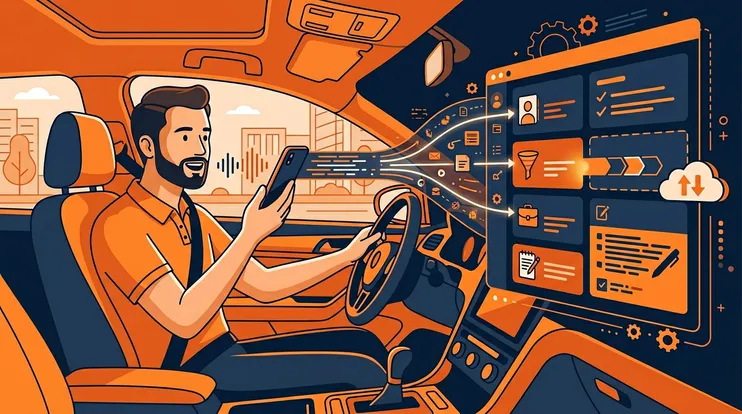
While the conversation is fresh, dictate what you discussed: the prospect's pain point, the product they were interested in, next steps you agreed on. Voice captures 3× more context than typing — and it takes a fifth of the time.
AI drafts a personalized email
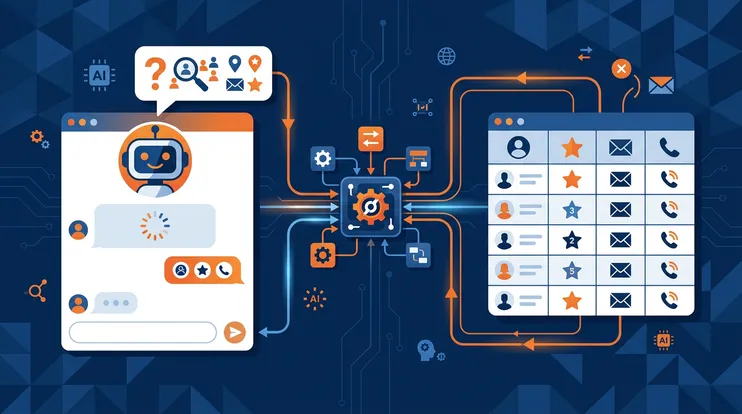
The AI uses your voice transcript, the prospect's contact data, your company's customer profile, and event-specific instructions to generate a follow-up email. Not a template — a message that references what was actually discussed.
Review and send
Read the draft, adjust if needed, and send directly from the app. The email goes out from your business email address (Gmail or Outlook) — not from a marketing automation tool.
CRM sync happens automatically
The lead, all context, and the sent email are synced to your CRM (HubSpot) automatically. No CSV exports, no manual data entry, no leads sitting in an app nobody checks after the event.
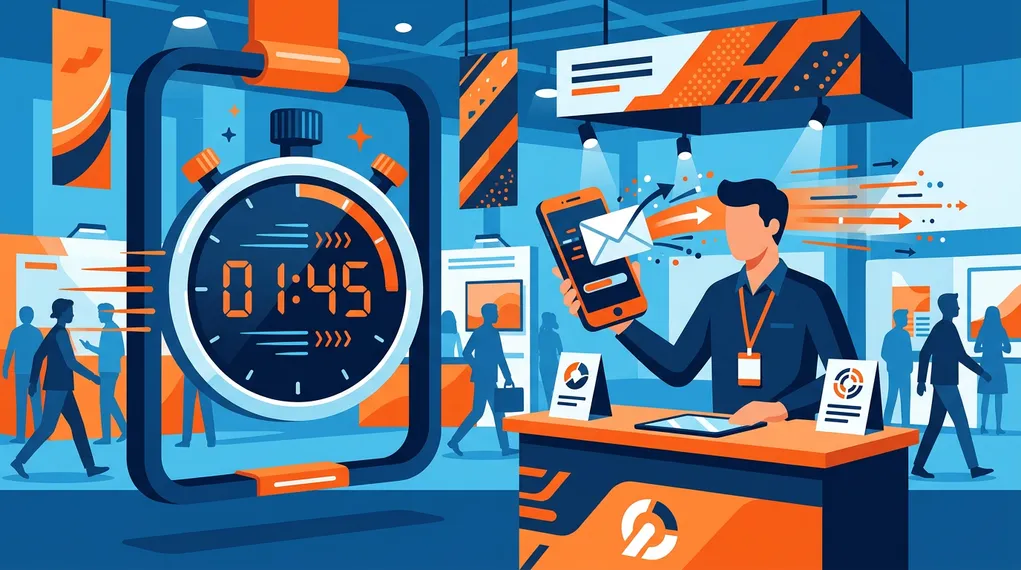
Total time: under two minutes. And the prospect receives a personalized email while they’re still at the event, while your conversation is still fresh in their mind.
Why Speed Alone Isn’t Enough
You could technically send a fast follow-up with a generic template: “Great meeting you at [Event Name], let’s connect!” That’s fast, but it’s also forgettable. Speed matters, but personalization is what converts.
The difference between a template email and a context-based follow-up is the difference between being remembered and being deleted. When your email references the specific challenge the prospect mentioned, the product they asked about, or the timeline they shared, it signals that you listened — and that you’re worth responding to.
This is why the voice note step is critical. It captures context that no badge scanner or form field can: the tone of the conversation, the specific objections raised, the offhand comment about their current vendor. That context is what turns a follow-up into a conversation.
For a deeper look at how context-based AI emails outperform templates, read our guide on AI follow-up emails and why context converts.
Traditional Follow-Up vs Real-Time Follow-Up
Let’s compare what happens in a typical post-event workflow versus the real-time approach.
Traditional workflow (2–5 day delay):
- Day 1–2: Export leads from badge scanner
- Day 2–3: Clean data, import into CRM
- Day 3–4: Segment leads, assign to reps
- Day 4–5: Write and send template-based emails
- Response rate: 2–5%
Real-time workflow (under 2 minutes):
- Second 0–30: Scan badge or card
- Second 30–60: Record voice context
- Second 60–90: AI generates personalized draft
- Second 90–120: Review and send
- Response rate: significantly higher — because the email is personal, timely, and relevant
The traditional approach isn’t just slower. It’s fundamentally different in kind. By the time a batch email arrives, the prospect has to reconstruct who you are and what you discussed. A real-time email arrives while the context is shared — both sides remember the conversation.
What About the Rest of the Day?
A common objection: “I can’t stop and send emails between every conversation. I’m at a booth — people are waiting.”
This is exactly why the workflow needs to take under two minutes. Scan, dictate, review, send. You can do this while walking back to your position, while your colleague takes the next prospect, or during a natural lull.
Some teams split the work: one person handles the conversation, another handles the scan and follow-up. With team features, the lead is automatically assigned and the follow-up can be triggered by either team member. For ready-to-use email examples and a proven multi-touch cadence, see our trade show follow-up email templates.
The point isn’t to spend your event day writing emails. It’s to eliminate the post-event email marathon entirely. Every follow-up sent at the booth is one fewer email to write at 11 PM in your hotel room.
Speed-to-Lead: The Research
The idea that faster follow-up produces better results isn’t new, but the data is more decisive than most teams realize.
InsideSales.com’s landmark study found that contacting a lead within five minutes is 21 times more effective than waiting 30 minutes. The study analyzed over 15,000 leads across multiple industries.
Harvard Business Review reported that companies responding within an hour are seven times more likely to qualify the lead than those who respond even one hour later — and 60 times more likely than those who wait 24 hours or more.
Applied to trade shows, the implications are stark. If your follow-up process takes days, you’re not just slow — you’re mathematically out of the game. The vendors who follow up same-day (let alone same-hour) capture a disproportionate share of the pipeline.
For more on why response time is the single biggest lever in event ROI, see our deep dive on speed to lead.
Making It Work Offline
Trade show floors are notorious for unreliable WiFi. Ten thousand attendees streaming, uploading, and downloading on the same network means you can’t count on a stable connection.
The workflow described above works offline. Badge scanning, voice recording, and AI draft generation all function without connectivity. When the connection returns, everything syncs — emails go out, leads hit the CRM, and nothing is lost.
This matters because the worst time to lose a lead is when you’re actually capturing it. If your tool requires a connection to scan a badge or record a note, it will fail at the exact moment you need it most. For a comprehensive overview of lead capture tools and their offline capabilities, see our honest comparison.
The Bottom Line
The gap between good and great event follow-up isn’t effort — it’s timing. The same email sent in two minutes converts dramatically better than the same email sent in two days.
The workflow is simple: scan, dictate, let AI draft, review, send, auto-sync. All at the booth, all in under two minutes, all before the next prospect walks up.
You don’t need a bigger team, a longer event day, or a more disciplined post-event process. You need a system that lets you follow up while the conversation is still warm. For the complete day-by-day framework for what comes after the first email, see our post-trade show playbook. And to understand what AI-powered follow-ups generate, explore our lead report feature.
Send your first follow-up in under 2 minutes. Try NeverDrop free.
Get Started Free