How to Capture Leads at Conferences Without a Booth
· 9 min read
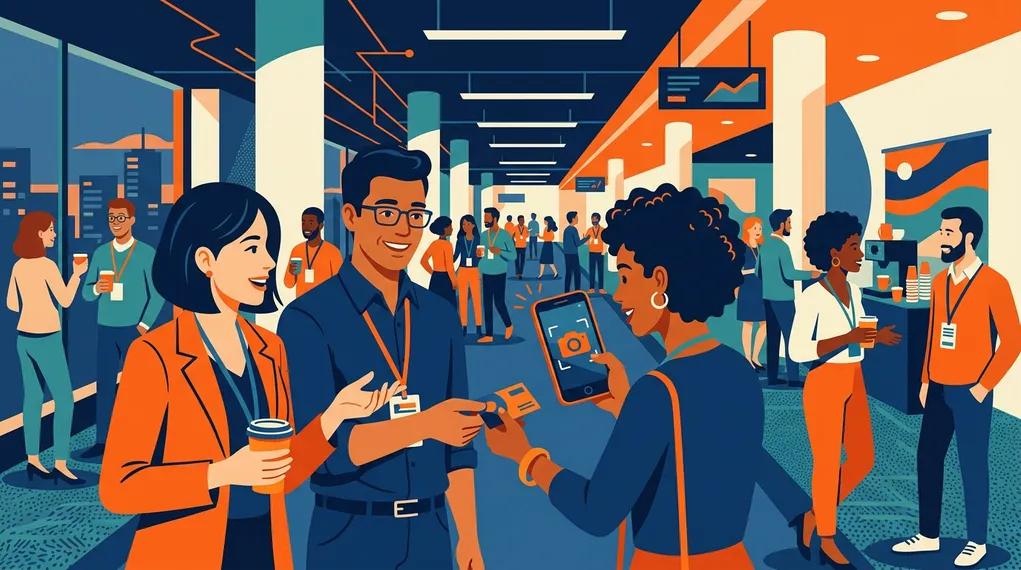
Not every event comes with a booth. In fact, some of the highest-value conversations at conferences happen outside the exhibition hall entirely: in hallways between sessions, at networking dinners, during coffee breaks, at the hotel bar after hours.
If you’re attending a conference as a participant — no booth, no badge scanner, no lead retrieval system — you face a specific challenge: every conversation is an opportunity, but you have no infrastructure to capture it. You exchange business cards, connect on LinkedIn, scribble notes on your phone, and hope you’ll remember the details when you sit down to follow up three days later.
You won’t. The details fade within hours. And the LinkedIn connection — while friendly — gives you zero control over the follow-up. The algorithm decides if they see your content. You’re not building a pipeline. You’re building a follower list.
70%
of conference attendees consider hallway conversations more valuable than formal sessions
PCMA — Convening Leaders Attendee Survey
This article covers five strategies for capturing leads at conferences when you don’t have a booth — and why systematic capture beats the “collect cards and hope” approach every time.
The Attendee’s Lead Capture Problem
Exhibitors have tools. They have badge scanners, lead retrieval apps, CRM integrations, and team workflows. They have a physical location where prospects come to them.
Attendees have none of that. As a conference attendee, your lead capture is improvised:
- You meet someone interesting during a breakout session
- You exchange business cards (if they have one)
- You make a mental note to follow up
- You move to the next session and meet three more people
- By dinner, you have a stack of cards and a jumble of half-remembered conversations
- By the flight home, you’ve lost the context that made each conversation valuable
The problem isn’t the conversations — it’s the gap between the conversation and the follow-up. Every hour that passes, context fades, urgency drops, and the connection loses value.
Strategy 1: Business Card Exchange + Instant Scan
Business cards are not dead. At conferences — especially international ones — they remain the default exchange medium. The problem isn’t the card. It’s what happens after.
The traditional workflow: collect cards → return to office → manually enter data → draft follow-ups → send. That’s a 3–5 day process that guarantees context loss.
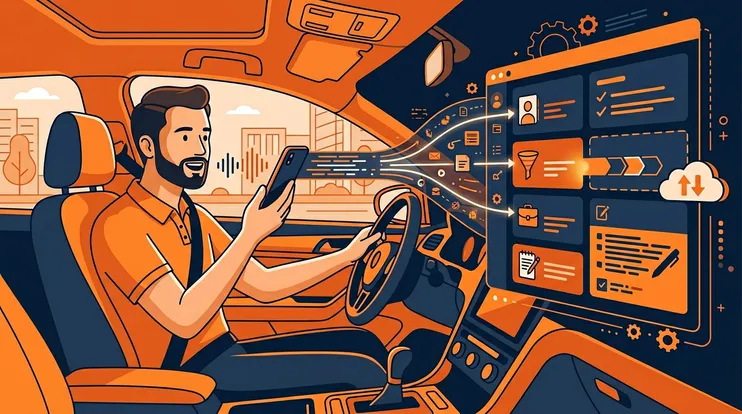
The instant workflow: exchange the card, scan it immediately with your phone, and let OCR extract the contact data. While the conversation is still fresh — perhaps while walking to the next session — record a 30-second voice note with the context: what you discussed, what they need, what the next step should be.
For a deep comparison of business card scanner approaches, including OCR accuracy and CRM sync, see our scanner guide. The key differentiator isn’t the scan itself — it’s the ability to attach conversation context and trigger AI-generated follow-ups from the same app.
Making it seamless
The best capture workflow is invisible. After exchanging a card:
- Pull out your phone (the prospect just did the same to check your card)
- Snap the card — OCR extracts name, title, company, email, phone in seconds
- While walking to the next session, record a quick voice note: “Met [Name] at the IoT panel. Their team is evaluating [specific solution]. Wants a 15-minute call next week.”
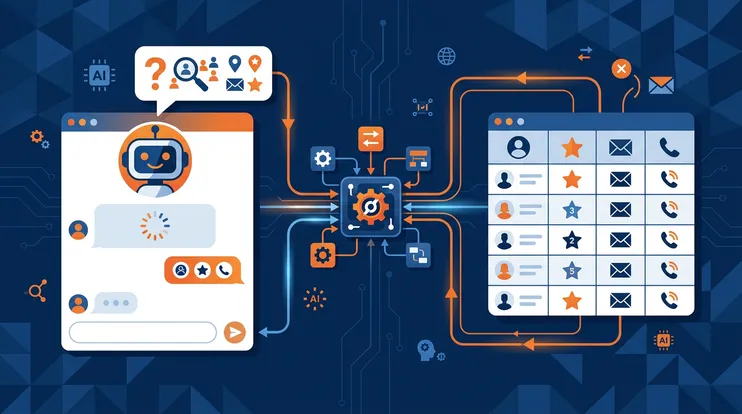
- AI drafts a personalized follow-up based on the contact data and your voice note
- Review and send — the prospect gets an email while still at the conference
Total time: under two minutes. Total context preserved: everything that matters. And because the AI draft is based on real conversation context, it outperforms every generic template in the prospect’s inbox.
Strategy 2: LinkedIn QR Code Scanning
When there’s no business card, LinkedIn’s QR code becomes the default exchange — especially at tech conferences and startup events.
The challenge: a LinkedIn connection is not a lead. You can’t email them (LinkedIn doesn’t expose email addresses). You can’t add them to your CRM. You can’t trigger a follow-up workflow. You’re relying on LinkedIn’s messaging and algorithm to maintain the relationship.
The better approach: use the LinkedIn exchange as one data point, then immediately capture the conversation context separately. Scan their card if they have one. If they don’t, enter their name and company manually — it takes 10 seconds — and record the voice note with conversation context.
The goal is to own the relationship data, not delegate it to a social platform. LinkedIn is for discovery. Your lead capture system is for conversion. Automatic email enrichment can fill in the verified work email address you won’t get from a LinkedIn connection.
Strategy 3: Voice Context Dictation Between Sessions
The hallway between sessions is the capture window. You have 5–10 minutes between talks. You just had two good conversations. What do you do?
Most attendees check their phone, grab coffee, and move on. The conversations are lost.
The systematic approach: spend 60 seconds between sessions dictating context for every conversation you just had. Not a formal transcript — a quick voice note:
“Met the CTO of [Company]. They’re struggling with [specific problem]. Currently using [competitor]. Timeline is Q3. Want a quick demo.”
That 15-second voice note preserves the intelligence that a business card alone can’t capture. When it’s transcribed and attached to the contact, it becomes the raw material for a personalized follow-up — not a generic “Great meeting you at [Conference]” template.
For a detailed comparison of voice notes versus written notes in lead capture scenarios, see our analysis. The short version: voice capture is 5× faster and preserves 3× more context than typed notes.
"The ROI of a conference isn't the sessions you attend — it's the conversations you capture and convert."
— Jill Rowley, Go-To-Market Advisor, Former Salesforce & HubSpot
Strategy 4: Conference Session Follow-Ups
Sessions themselves are lead generation opportunities — if you capture them correctly.
Sitting in a panel discussion, you overhear the person next to you ask a sharp question about a problem your product solves. After the session, you introduce yourself: “That question about [topic] — we actually solve that. Can I show you?”
Or you’re in a workshop, and the facilitator mentions a challenge that aligns perfectly with your solution. You approach them after the session with a specific angle.
These are warm introductions — warmer than any cold email or booth conversation, because they’re grounded in shared context. The prospect asked the question. You have the answer.
Capturing session leads
The same workflow applies:
- Exchange contact information (card, LinkedIn, or manual entry)
- Record context: “Met [Name] after the supply chain panel. She asked about [specific topic]. Their team has [X problem]. I offered a demo — she said yes.”
- Send the follow-up within the hour — referencing the session, the question, and the solution
The follow-up email that says “I heard your question about [topic] at the [Session Name] panel — here’s how we approach that problem” outperforms every generic conference follow-up by an order of magnitude.
Strategy 5: Post-Event Email Personalization
Even if you don’t capture everything in real time, the first 24 hours after a conference are recoverable. This is your last window to turn conversations into pipeline.
Business card exchange + instant scan
Scan every card immediately. Record a 30-second voice note with conversation context. Let AI draft a personalized follow-up. Send before the next session.
LinkedIn QR + separate lead capture
Connect on LinkedIn for social proof, but capture the contact data and conversation context in your lead capture tool. Own the relationship data.
Voice context dictation between sessions
Spend 60 seconds between sessions dictating context for every conversation. Voice capture is 5× faster than typing and preserves 3× more detail.
Conference session follow-ups
Session Q&A creates warm introductions. Capture the person, the question they asked, and the solution you offered. Follow up referencing the specific session.
Post-event email personalization within 24 hours
Go through every card and contact from the event. For each one, record a voice note with what you remember. Send personalized follow-ups before the context window closes.
Sit down the evening of the conference — or the morning after — and go through every card, every contact, every connection. For each one:
- What did you discuss?
- What’s their specific need?
- What’s the logical next step?
Record this as a voice note, attach it to the contact, and send the follow-up. The email doesn’t need to be long — three sentences that show you listened and have a clear proposal.
The attendees who do this within 24 hours will capture 80% of the available value. The ones who wait until they’re “back in the office” will capture almost none. Speed to lead research confirms that the first five minutes after a conversation are worth more than the next five days.
Why This Beats LinkedIn Connections
The instinct at conferences is to connect on LinkedIn. It’s easy, it’s polite, and it feels like progress. But a LinkedIn connection is not a lead in your pipeline. Here’s the difference:
LinkedIn connection: You have their profile. They might see your posts. You can send them a DM (that competes with 50 other DMs). You don’t have their email. You can’t add them to a follow-up sequence. The relationship is mediated by a platform you don’t control.
Captured lead with context: You have their email, phone, company, and role. You have a transcript or voice note of what you discussed. You have an AI-drafted follow-up that references the specific conversation. You can add them to your CRM. The relationship is yours.
One approach builds an audience. The other builds a pipeline. For a comprehensive framework on event lead capture, including both booth and boothless scenarios, see our complete guide.
The No-Booth Advantage
Here’s the counterintuitive truth: not having a booth can actually be an advantage.
Booth conversations are often transactional. The prospect walks up, asks for a demo, collects a brochure, and moves on. The conversation follows a predictable script.
Hallway conversations, dinner conversations, after-party conversations — these are relationship conversations. They’re longer, more candid, more personal. The prospect isn’t in “vendor evaluation” mode. They’re in “problem discussion” mode. The insights you capture are richer, the connection is deeper, and the follow-up is more natural.
The key is having a system to capture those organic conversations with the same rigor that exhibitors bring to their booth. Install NeverDrop on your phone before the next conference, and every hallway conversation becomes a captured lead with context, ready for a personalized follow-up. See our tool comparison page for how NeverDrop stacks up against other options.
92%
of conference attendees say networking is a top reason for attending
Bizzabo — Event Marketing Benchmarks Report
The 92% are right — networking is why conferences exist. But networking without capture is socializing. Networking with systematic capture and follow-up is sales.
No booth? No problem. Capture every conference conversation, add context with voice notes, and follow up with AI-personalized emails.
Get Started Free