Speed-to-Lead: Why the First 5 Minutes After a Handshake Matter Most
· 9 min read
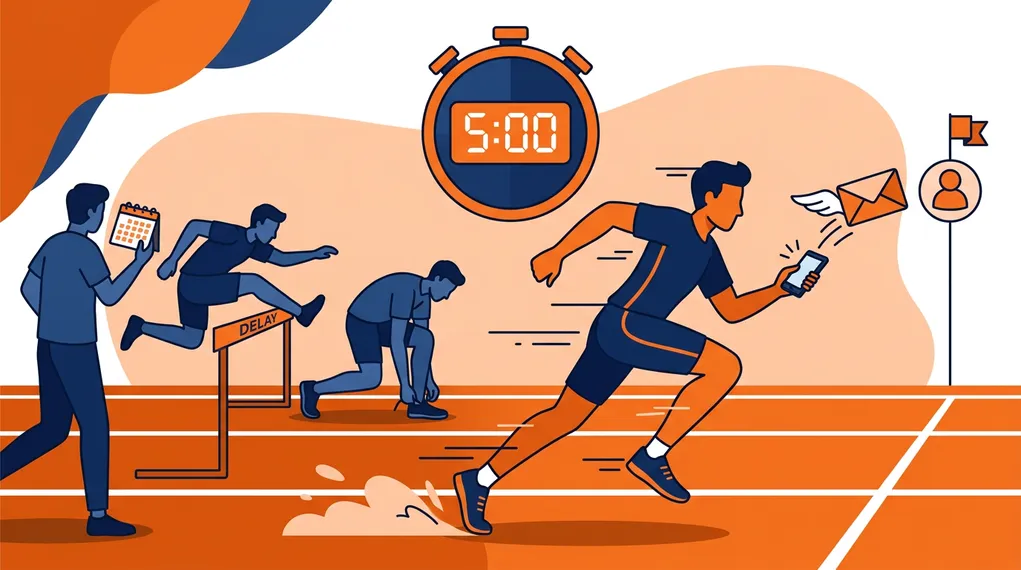
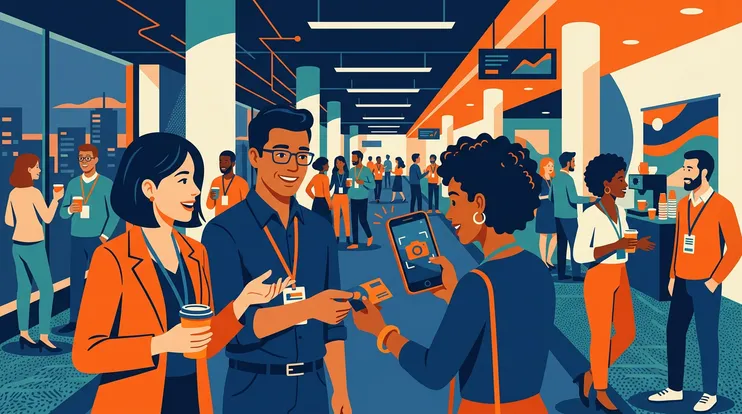
There’s a narrow window after every trade show conversation where you have an unfair advantage. The prospect remembers your face. They remember the conversation. They remember the problem they described and the solution you proposed. Their attention is yours — but only for a few minutes.
Miss that window, and you’re just another name in their inbox. Hit it, and you’re the vendor who was fast, personal, and organized — three qualities that signal competence long before the first demo.
21×
higher conversion when you respond within 5 minutes vs. 30 minutes
InsideSales.com / Lead Response Management Study
Speed-to-lead isn’t a new concept. Sales teams have talked about it for a decade. But at trade shows and events — where leads are the most expensive to acquire and the most perishable — it’s the single most neglected lever.
The Research: What the Data Says
The body of research on response time and lead conversion is extensive and consistent.
InsideSales.com (now XANT) analyzed over 15,000 leads and found that contacting a lead within five minutes of first contact makes you 21 times more likely to qualify them than if you wait 30 minutes. At 10 minutes, the odds have already dropped by 4×.
Harvard Business Review studied 1.25 million sales leads and found that companies responding within one hour are 7× more likely to qualify the lead than those who respond even one hour later — and 60× more likely than those who wait 24 hours.
"50% of buyers choose the vendor that responds first. Not the cheapest. Not the best. The first."
— Dr. James Oldroyd, Lead Researcher, InsideSales.com Lead Response Study
Drift’s 2023 State of Conversational Marketing found that the average B2B company takes 42 hours to respond to a lead. Only 7% of companies respond within five minutes. That means 93% of companies are structurally disadvantaged before they even start competing on product or price.
Applied to trade shows, these numbers are even more striking — because event leads are warmer, more expensive, and more competitive than inbound web leads. The speed advantage compounds.
Why Speed Matters at Events
The general speed-to-lead research applies to web form submissions, demo requests, and inbound inquiries. At trade shows and events, the dynamics are amplified.
Recency Bias
Cognitive psychologists call it the “recency effect” — people disproportionately remember and favor the most recent interaction. A prospect at a multi-day trade show speaks with 30–50 vendors. The conversations blend together. The vendor who follows up first anchors the prospect’s memory: “They were the responsive ones.”
An email that arrives while the prospect is still at the event, still processing the conversation, cuts through in a way that a Tuesday morning inbox blast never will.
The Attention Window
A trade show prospect’s attention window is measured in hours, not days. On the show floor, they’re focused on solutions to their problems. That evening, they’re processing business cards and reviewing notes. The next morning, they’re back at the show with a new agenda. By the following week, they’re back at their desk, buried in the work that piled up while they were away.
Your follow-up competes with every other vendor and every other priority. Earlier is exponentially better.
Competitive Advantage
At any given trade show, your competitors are talking to the same prospects. The vendor who follows up first claims the pole position. Research shows that 35–50% of sales go to the first responder — not because they have the best product, but because they demonstrated urgency and competence.
If your competitor sends a personalized email from the booth and you send a template three days later, you’ve already lost the positioning battle. Price and features become irrelevant when the prospect has already built rapport with the faster vendor.
The Math of Delay
Response time doesn’t just affect conversion rates — it affects response rates, which affect everything downstream.
Within 5 minutes: 30–45% email response rate. Prospect remembers the conversation vividly. Follow-up feels like a natural continuation, not a cold outreach.
Within 1 hour: 25–35% response rate. Prospect is still at the event, still in “buying mode.” Your email lands in a window of receptivity.
Within 24 hours: 15–25% response rate. Prospect has returned to hotel or traveled home. Memory of the conversation is fading. Your email competes with event fatigue.
24–48 hours: 8–15% response rate. Prospect is back at work. The trade show is becoming a blur. Your email is now one of dozens in a post-event inbox.
3–5 days: 5–10% response rate. The details of your conversation are gone. The follow-up has to re-establish context from scratch — which is what templates try to do, and why they fail.
5+ days: 2–5% response rate. At this point, you’re effectively cold-emailing a person you already paid to meet in person. For an analysis of what this pattern costs you financially, see our breakdown of the real cost of losing a trade show lead. To understand the full ROI impact of delay at scale, use our trade show ROI calculator.
38%
of exhibitors wait 6+ days to follow up with trade show leads
Exhibit Surveys — Post-Show Follow-Up Report
The 38% who wait 6+ days aren’t just slow — they’re mathematically eliminated from converting the vast majority of their leads. They paid full price for the event and then opted out of the ROI.
Yet Only 22% Follow Up Same-Day
Given how clear the research is, you’d expect every exhibitor to prioritize same-day follow-up. They don’t. Industry surveys consistently show:
- 22% of exhibitors follow up within 24 hours
- 40% of exhibitors follow up within 1–5 days
- 38% of exhibitors take 6+ days — or never follow up at all
The gap between knowing and doing is enormous. And it’s not because sales teams are negligent. It’s because the standard workflow makes speed structurally impossible.
Think about the typical process: scan badges all day → export CSV after the event → import into CRM → segment and assign → write emails → send. Even with a disciplined team, this takes 3–5 business days. The tools were designed for batch processing, not real-time engagement.
The First-Responder Advantage
Military and emergency services use the term “first responder” for the person who arrives at the scene first and takes action. In sales, the first responder is the vendor who reaches the prospect first after initial contact.
The first-responder advantage is not marginal. Studies suggest that 35–50% of deals go to the vendor who responds first — regardless of whether they ultimately have the best product or the lowest price. The reason is psychological:
Competence signaling: A fast, personalized response signals that you’re organized, capable, and serious. It’s a proxy for how you’ll treat them as a customer.
Anchoring: The first substantive follow-up sets the terms of comparison. Every subsequent vendor email is compared against your initial outreach — tone, relevance, personalization.
Reciprocity: The prospect invested time in a conversation with you. A fast, contextual follow-up reciprocates that investment and creates an obligation to respond. A slow, generic email wastes their time a second time.
How to Achieve Sub-2-Minute Follow-Up
The research is clear. The math is unambiguous. The question is execution.
The workflow that makes sub-2-minute follow-up possible has five steps:
- Scan the badge or business card — OCR extracts contact data automatically (10 seconds)
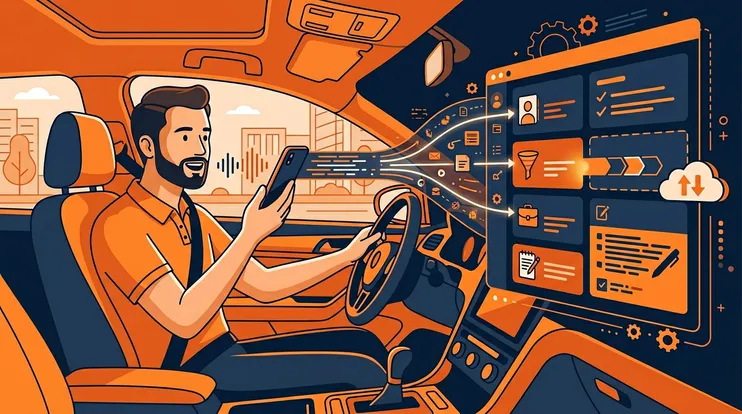
- Record a voice note — dictate the conversation context while it’s fresh (30 seconds)
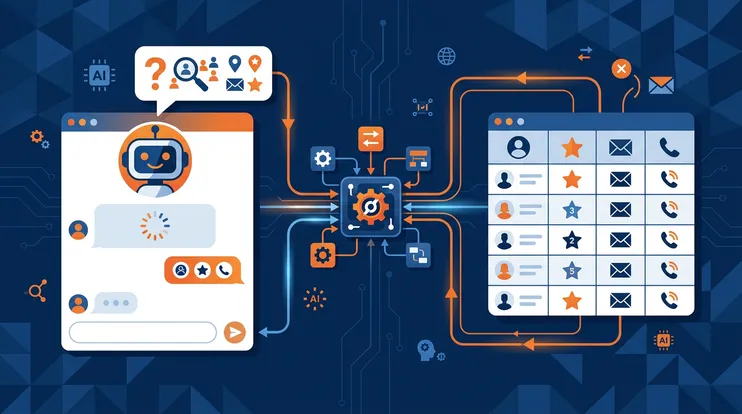
- AI drafts a personalized email — using the transcript, contact data, and your company context (automatic)
- Review and send — from your business email address (30 seconds)
- CRM sync — lead, context, and sent email sync to your CRM automatically (background)
That’s the complete capture-to-follow-up pipeline in under two minutes. For a step-by-step walkthrough with timing benchmarks, see our guide on how to follow up in under two minutes.
The key enabler is AI-drafted personalization. Speed without relevance is spam. The reason most teams can’t follow up fast is that writing a genuinely personalized email takes time. AI collapses that step from minutes to seconds — using the voice transcript to reference what was actually discussed, not just the prospect’s name and company.
For a deep look at how AI follow-up emails use context to convert, see our comparison of template-based vs. context-based approaches.
Speed-to-Lead as a Competitive Strategy
Most exhibitors treat follow-up speed as an operational detail — something to optimize at the margins. The highest-performing teams treat it as a core competitive strategy.
When your competitors take 3–5 days to follow up and you do it in 2 minutes, you don’t just win on timing — you win on perception. The prospect sees a company that executes. A company that follows through. A company that treats their time as valuable.
That perception carries forward through the entire sales cycle. The vendor who was fast at the booth is expected to be fast on proposals, fast on support, fast on implementation. Speed-to-lead doesn’t just close the current deal — it frames the relationship.
Making It Systematic
Individual effort isn’t enough. One rep who follows up fast while three others batch-process doesn’t move the needle. Speed-to-lead must be systematic:
- Equip every booth team member with the same capture and follow-up workflow
- Set a team target: 90%+ same-day follow-up rate (ideally same-minute)
- Track it in real time: daily lead count vs. same-day follow-up count
- Debrief daily: which leads were followed up immediately? Which weren’t? Why?
The exhibitors who turn speed-to-lead from an aspiration into a system are the ones who consistently outperform — not because they have better products or bigger booths, but because they converted their investment into pipeline while their competitors were still packing up. For the complete day-by-day framework, see our post-trade show playbook. And for the broader strategy covering everything from card scanning to CRM sync, start with our complete guide to event lead capture.
Frequently Asked Questions
Speed to lead measures the time between a prospect's first interaction and your first follow-up. In the context of trade shows, it's the gap between shaking hands at the booth and sending a personalized email. Research from InsideSales.com and HBR shows this metric directly predicts conversion rates.
Within 5 minutes is ideal. The InsideSales.com study found that leads contacted within 5 minutes are 21× more likely to convert than those contacted after 30 minutes. At trade shows, this means sending a personalized follow-up before you leave the booth — which is achievable with AI-powered tools.
Yes, dramatically. Leads contacted within 1 hour are 7× more likely to have a meaningful conversation than those contacted after 1 hour, and 60× more likely than those contacted after 24 hours. At events, the decay is even faster because prospects meet dozens of vendors.
Follow up in under 2 minutes with AI-powered personalization. Try NeverDrop free.
Get Started Free