The Real Cost of Losing a Trade Show Lead
· 9 min read
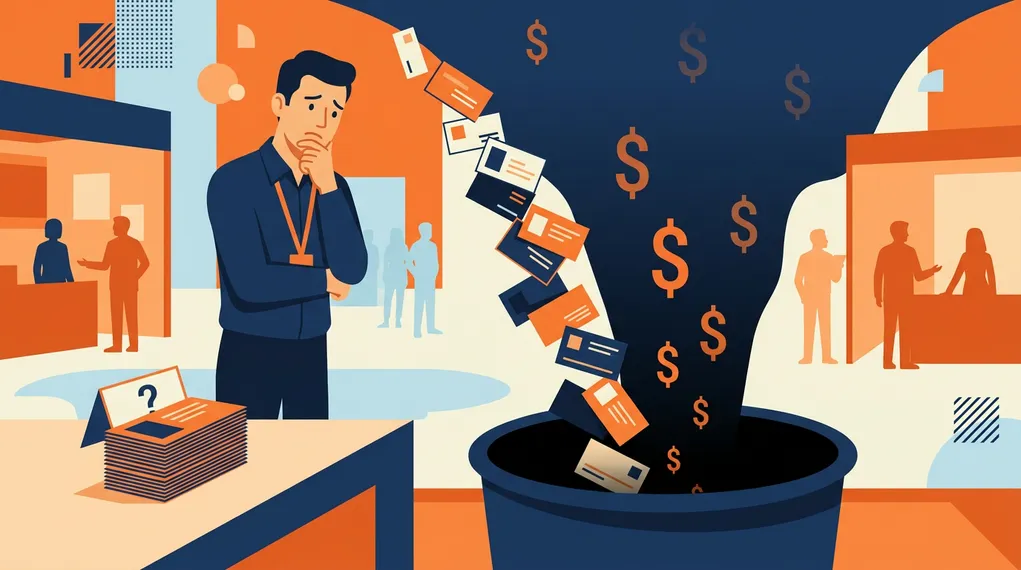
Here’s a number nobody likes to think about: the average B2B exhibitor loses four out of every five leads they capture at a trade show. Not because the leads are bad. Not because the sales team is lazy. Because the process between capturing a lead and following up is so broken that 80% of contacts never receive a single response.
80%
of trade show leads never receive any follow-up
CEIR — Center for Exhibition Industry Research
That statistic has been cited for years and it hasn’t improved. The industry has upgraded from paper to badge scanners to mobile apps, but the follow-up gap persists because the fundamental problem was never about capture technology — it’s about the workflow that happens after the scan.
Let’s do the math on what that gap actually costs.
The Cost-Per-Lead Calculation
Start with the basics. Take your total event investment — booth, travel, staff time, technology, collateral, the lot — and divide it by the number of leads captured.
Cost Per Lead = Total Event Investment ÷ Leads Captured
For most B2B trade shows, this number lands between $150 and $500 per lead, depending on event size, booth tier, and team size. At a major industry conference with a premium booth, it can exceed $600.
$150–$500
average cost per lead at B2B trade shows
Exhibit Surveys / CEIR Benchmarking Report
This number represents what you paid — in hard dollars and staff time — to get that person to stop at your booth, have a conversation, and share their contact information. Every unfollowed lead is that investment, incinerated.
The Math of 80% Waste
Let’s make this concrete.
Scenario: Your team attends a major industry trade show. Total investment (booth, travel, staff, technology, materials): assume a significant all-in spend. You capture 50 qualified leads over three days.
At those numbers, each lead cost you a meaningful share of the total budget to acquire. Now apply the industry average: 80% don’t receive follow-up. That means 40 of your 50 leads get nothing. No email. No call. No LinkedIn message. The handshake was the last touchpoint.
The 40 unfollowed leads represent 80% of your event investment — gone. Not lost to competitors. Not lost to bad timing. Lost to your own process.
You didn’t attend a trade show. You attended 20% of one.
The Compounding Cost
The cost-per-lead figure only captures the direct loss. The real cost compounds through three layers.
Layer 1: The Lost Deal
Each unfollowed lead had a probability of converting. Even conservative conversion rates applied to your average deal value mean that 40 lost leads represent a substantial amount of potential pipeline. For most B2B companies, the expected revenue from 40 abandoned leads dwarfs the cost of the event itself.
Layer 2: The Lost Referrals
B2B sales are networked. A closed customer refers colleagues, introduces you to other teams, and creates second-order pipeline. When you lose the initial lead, you lose the entire downstream network. Research from Texas Tech suggests that 83% of satisfied customers are willing to make referrals, but only 29% do — because nobody asks. You can’t ask if you never followed up.
Layer 3: The Lost Relationship
The prospect you ignored at the trade show doesn’t forget. They remember the conversation. They remember the handshake. They remember the promise to follow up. When your competitor sends a personalized message the same day and you send nothing for a week — or ever — the signal is clear: you don’t value their time.
This isn’t hypothetical. Every B2B buyer has a story about the vendor who was great at the booth and then disappeared. You don’t want to be that vendor.
Why Leads Get Lost
If the cost is this high, why does it keep happening? Because losing leads is a systems problem, not a people problem.
The Batch Processing Trap
The standard workflow: scan badges all day, export a CSV post-event, import into the CRM, segment, write templates, and send. Every step introduces a delay, and every delay kills conversion rates.
Day one at the show, the leads are warm and the conversations are vivid. By day three of post-event processing, the leads are names on a spreadsheet and the conversations are half-remembered fragments. The follow-up email — if it ever goes out — is generic because nobody can recall what was actually discussed.
The Context Evaporation Problem
Badge scanners capture contact data but not conversation context. By the time the rep sits down to write the follow-up, they can’t remember whether the prospect asked about pricing, integration, or implementation. So they send a template. Templates get deleted.
The quality of your CRM data from trade shows directly reflects how much context was captured at the point of conversation. No context captured means no personalization possible means no response.
The Priority Drain
After a multi-day trade show, the sales team returns to a full inbox of existing deals, internal meetings, and pipeline that went cold while they were away. The event leads — sitting in a CSV or an app nobody checks — lose to the urgency of whatever’s already in the CRM. Not because they’re less important, but because they’re less visible.
The Ownership Vacuum
When leads aren’t assigned to specific reps at the time of capture, nobody owns them. “We’ll sort out the leads after the event” means nobody sorts them. Leads that belong to everyone belong to no one.
What Each Day of Delay Costs
The data on follow-up timing and response rates is stark.
Research from InsideSales.com and Harvard Business Review consistently shows the same pattern:
- Under 5 minutes: Leads contacted in this window convert at dramatically higher rates — up to 21× better than waiting even 30 minutes
- Under 24 hours: Response rates hold in the 30–45% range. Prospects still remember the conversation clearly.
- 24–48 hours: Response rates drop to 15–25%. The prospect has spoken with 20 other vendors and the details are blurring.
- 3–5 days: Response rates fall to 8–15%. Your email is now one of dozens they received post-event.
- 5+ days: Response rates collapse to 2–5%. You’re effectively cold-emailing someone you already paid to meet in person.
Every day of delay reduces the value of the lead you already paid to capture. A lead followed up in five minutes is worth the full cost-per-lead investment. A lead followed up after a week is worth a fraction. For a deep dive into why the first five minutes matter most, see our speed-to-lead research.
Changing the Math
The problem isn’t that trade shows don’t work. The problem is that the capture-to-follow-up workflow hasn’t kept pace with the investment.
The fix requires three changes:
1. Follow Up in Real Time, Not in Batch
The single highest-ROI change is moving follow-up from “after the event” to “at the booth.” When every lead receives a personalized email within minutes of the conversation, the 80% loss rate collapses. You can’t lose a lead you’ve already followed up with. See our guide on how to follow up with trade show leads in under two minutes.
2. Capture Context, Not Just Contact Data
A name and email aren’t enough to write a follow-up that gets a response. You need the conversation context: what they asked about, what challenge they’re facing, what next steps were discussed. Voice notes capture this in 30 seconds. For a complete breakdown of how voice transcription transforms lead capture, see our features overview.
3. Automate the CRM Sync
If leads don’t reach the CRM automatically — with context, qualification, and follow-up history — they’ll sit in an app or spreadsheet until someone manually processes them. That someone is busy. The leads will wait. The leads will die.
Automated sync means the lead, the conversation transcript, the AI-generated follow-up, and the qualification data all land in your CRM within minutes of the conversation. No CSV exports. No batch imports. No manual data entry. For the complete workflow from capture to CRM, see our complete guide to event lead capture.
The ROI of Not Losing Leads
Flip the math. If your current process loses 80% of leads, and you can reduce that to 10% or less, you’ve just 5בd the output of every event you attend — with zero increase in booth spend, travel cost, or team size.
That’s not a marginal improvement. It’s a structural one. The event that was “okay” at 20% follow-through becomes genuinely transformative at 90%+ follow-through. For a complete framework on how to calculate your trade show ROI and measure the impact, see our ROI guide.
The exhibitors who are winning in 2026 aren’t spending more on booths. They’re spending less on leads that get lost. They’re capturing with context, following up in minutes, syncing automatically, and converting the investment they’ve already made. For a structured approach to the first week after a show, see our post-trade show follow-up playbook.
The most expensive lead at any trade show isn’t the one that costs the most to capture. It’s the one you already paid for and never followed up.
Frequently Asked Questions
Between $150-500 per lead, calculated by dividing total event costs (booth, travel, technology, staff time) by number of meaningful interactions. At a $50,000 event where your team has 100 conversations, each lead costs $500 before follow-up.
Only 20% according to industry research. That means 80% of your trade show investment — the booth, the travel, the time — generates zero return. The primary cause is the gap between capture and follow-up: leads pile up, context evaporates, and reps move on to the next event.
Three structural fixes: capture instantly (scan + voice note, not pocket the card), follow up immediately (AI-drafted email before you leave the booth), and assign ownership (every lead has one responsible rep with a deadline). Tools like NeverDrop automate all three.
Stop losing the leads you already paid for. Try NeverDrop free.
Get Started Free