Email Enrichment for Events: How to Find Verified Emails from a Business Card
· 8 min read
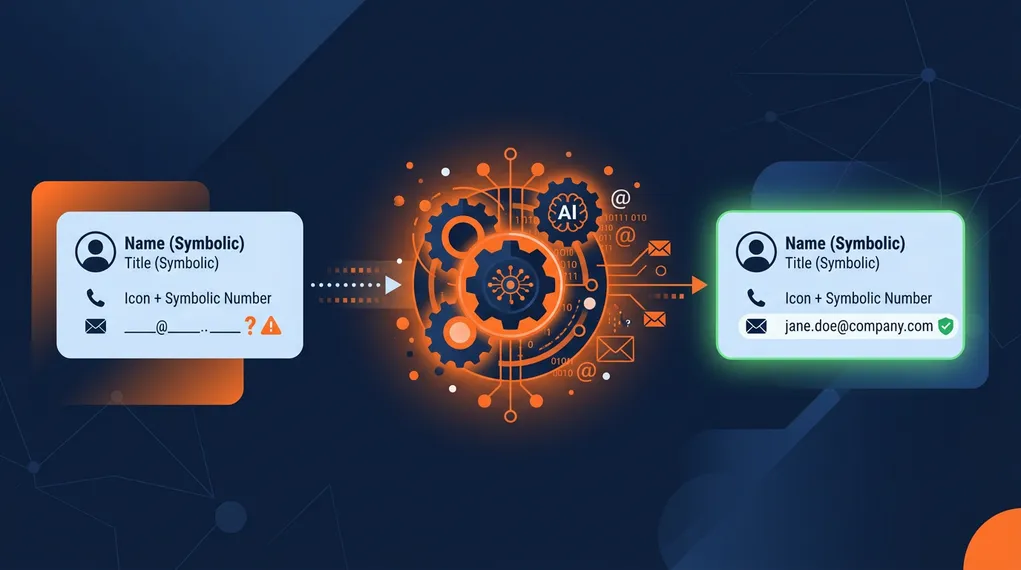
You just had a great conversation at a trade show. The prospect handed you their business card. You scan it, and the card shows a name, a title, a company — and a Gmail address. Or no email at all.
This is more common than most sales teams realize. Business cards are designed for networking, not for CRM data entry. Many professionals list personal emails, generic department inboxes, or simply skip the email field entirely. And without a verified professional email, your carefully crafted follow-up has nowhere to go.
40%
of business cards collected at events contain no professional email address
FullEnrich / DiscoverOrg
That’s nearly half your pipeline sitting in limbo — not because the lead wasn’t interested, but because you don’t have the right address. Email enrichment solves this gap, and when it’s automated into your event workflow, it eliminates one of the biggest bottlenecks in trade show follow-up.
The Business Card Email Problem
Business cards fail as data sources for three distinct reasons:
No email at all. Some cards only list phone numbers and physical addresses. This is especially common in industries like manufacturing, construction, and healthcare where email isn’t the primary communication channel.
Personal email addresses. Many professionals print personal Gmail, Yahoo, or Outlook addresses on their cards — either because their corporate email changes frequently (consultants, contractors) or because they prefer to keep their corporate inbox clean. A follow-up sent to a personal address feels intrusive and often gets ignored.
Generic inboxes. Cards that list info@company.com or sales@company.com are effectively dead ends. Your personalized follow-up disappears into a shared inbox that nobody monitors after events.
Outdated addresses. People change jobs, companies rebrand, domains change. A card printed six months ago may have an email that bounces today.
The result: even after a successful badge scanning workflow at an event, a significant portion of your contacts lack the one data point you need most — a verified, deliverable professional email address.
What Email Enrichment Actually Does
Email enrichment is the process of finding a verified professional email address using the information you already have: the person’s name and their company.
Here’s how modern enrichment services work under the hood:
Data aggregation. Enrichment providers aggregate professional contact data from multiple sources — public business registries, professional directories, corporate websites, email pattern databases, and proprietary data partnerships. The best providers cross-reference dozens of sources per query.
Pattern matching. Most companies follow predictable email patterns: firstname.lastname@company.com, f.lastname@company.com, firstname@company.com. The enrichment engine identifies the pattern used by the target company and generates candidate addresses.
Verification. This is the critical step. Generating a candidate address is easy — verifying it’s real and deliverable is what separates enrichment from guessing. Verification checks include MX record validation, SMTP handshake testing, catch-all detection, and deliverability scoring. A result is only returned if the confidence exceeds a minimum threshold.
Confidence scoring. Not all results are equally reliable. Enrichment services assign confidence scores based on the number of confirming sources, the age of the data, and the verification result. High-confidence results (typically 90%+) are safe to use directly. Lower-confidence results may need manual review.
The entire process takes seconds per contact, and the best implementations handle it automatically — no manual lookup, no guessing, no Chrome extensions.
Why It Matters for Event Follow-Up
The connection between email enrichment and follow-up effectiveness is straightforward but worth making explicit.
You can’t follow up without an email. If your event lead capture workflow captures a lead but doesn’t produce a deliverable email address, that lead is stuck. It sits in your CRM as an incomplete record — visible in reports, counted in metrics, but unreachable. Many teams don’t discover these gaps until days after the event, when the follow-up window has already closed.
Speed depends on data completeness. The research on follow-up timing is clear: responding within minutes produces dramatically higher conversion rates. But speed requires having the email ready the moment the conversation ends. If your workflow includes a “look up their email later” step, you’ve introduced a delay that no amount of urgency can recover.
Manual lookup doesn’t scale. A salesperson who captures 30–50 leads per day at a trade show cannot manually research each missing email. LinkedIn stalking, website crawling, and email guessing tools are slow, unreliable, and distract from what the salesperson should be doing: having conversations.
Bad emails destroy deliverability. Guessing email addresses and sending to unverified addresses tanks your domain’s sender reputation. Bounced emails trigger spam filters, and once your domain is flagged, even your verified sends get filtered. Enrichment with verification is the only safe approach.
How Auto-Enrichment Works in Practice
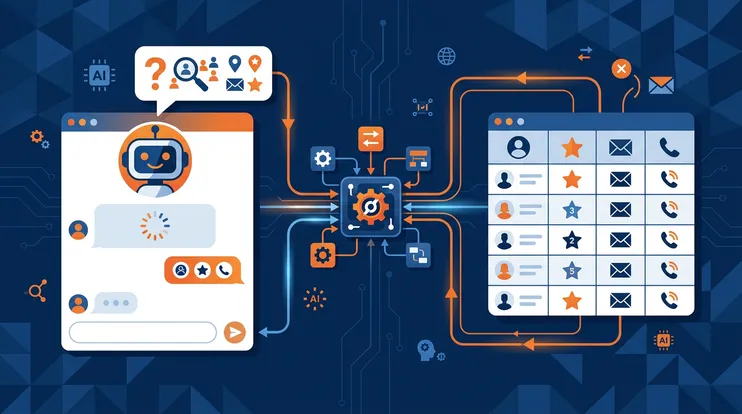
The ideal workflow removes enrichment from the salesperson’s task list entirely. Here’s how NeverDrop’s auto-enrichment handles it:
Badge or card scan
The salesperson scans a badge or business card. OCR extracts all visible data — name, title, company, and any email or phone printed on the card.
Data gap detection
The system checks whether a professional email was found. If the card had no email, a personal email, or a generic inbox, it triggers enrichment automatically.
Enrichment query
Using the person's name and company, the enrichment engine queries multiple data providers simultaneously. Results are cross-referenced and verified for deliverability.
Verified result delivered
The verified professional email is written back to the contact record. The salesperson sees it appear in the lead card without lifting a finger.
Follow-up ready
With a verified email in place, the AI draft can be generated and sent immediately. No manual lookup step, no delay.
The entire enrichment cycle typically completes within 10–30 seconds. By the time the salesperson finishes adding their conversation notes, the email is already there.
What Happens Without Enrichment
Let’s compare three approaches to the missing-email problem and their real-world impact on follow-up effectiveness:
| No enrichment | Manual lookup | Auto enrichment | |
|---|---|---|---|
| Time per lead | 0 min (but no follow-up possible) | 3–5 min per lead | 0 min (automated) |
| Email accuracy | N/A — no email found | 60–70% (guessing + basic checks) | 95%+ (multi-source verification) |
| Follow-up delay | Days (or never) | Hours (batch research) | Minutes (instant) |
| Scalable to 50+ leads/day | ✗ | ✗ | ✓ |
| Sender reputation risk | N/A | High (unverified sends) | Low (verified only) |
| Sales rep effort | None (lead abandoned) | Significant | None (automatic) |
The “no enrichment” scenario is the most common — and the most damaging. Those leads don’t appear in lost-deal reports because they never entered the pipeline. They’re invisible losses.
Beyond Email: Phone Enrichment
Email isn’t the only contact data that benefits from enrichment. Phone numbers are equally valuable for event follow-up — especially for high-value leads where a phone call is more appropriate than an email.
Phone enrichment works similarly: given a name and company, the service queries professional databases to find a verified direct dial or mobile number. This is particularly useful for:
- Senior decision-makers who rarely respond to cold emails but will take a warm call referencing a recent conversation
- Time-sensitive opportunities where a phone call can accelerate the decision timeline
- Multi-channel follow-up where an email + call combination produces higher response rates
NeverDrop supports both email and phone enrichment, with phone enrichment available as an optional auto-trigger after badge scans for teams that want maximum contact data coverage.
The Enrichment Economics
Enrichment isn’t free — data providers charge per successful lookup. But the economics are overwhelmingly favorable when you consider the alternative.
A single qualified lead at a major trade show represents significant pipeline value. The booth space, travel, and personnel costs to generate that lead are substantial. Losing the lead because you couldn’t find an email address is the most expensive possible outcome — all the acquisition cost with zero return.
Enrichment recovers these otherwise-lost leads. Even a modest 60–70% success rate on enrichment means you’re recovering the majority of your missing-email leads. For most teams, enrichment pays for itself on the first lead it saves.
Best Practices for Event Email Enrichment
Enrich immediately, not in batch. The value of enrichment drops rapidly with time. An email found 30 seconds after the scan enables instant follow-up. An email found two days later in a batch process is barely better than manual lookup.
Don’t skip verification. Finding a candidate email is meaningless without verification. An unverified email that bounces is worse than no email at all — it damages your sender reputation and wastes the follow-up.
Use enrichment as a complement to OCR, not a replacement. If the business card has a valid professional email, use it. Enrichment should fill gaps, not override what the prospect explicitly provided.
Monitor enrichment rates by event. Track what percentage of scans require enrichment and what the success rate is. This data helps you understand your lead quality by event and adjust your badge scanning strategy accordingly.
Combine with conversation context. An enriched email is only half the equation. The real power comes when enrichment provides the delivery address and AI-generated follow-ups provide the content. Together, they ensure every lead gets a personalized, timely follow-up — even when the business card was incomplete.
The Complete Picture
Email enrichment is a quiet but critical piece of the event lead capture puzzle. It doesn’t make headlines like AI-generated drafts or real-time transcription, but without it, those capabilities have nowhere to deliver their value.
The math is simple: if 40% of your event contacts lack a usable email, and your follow-up workflow doesn’t include enrichment, you’re leaving 40% of your event ROI on the table. Not because those leads weren’t interested — but because you couldn’t reach them.
Auto-enrichment closes this gap invisibly. The salesperson scans, talks, and follows up. The enrichment happens in the background, and the verified email is there when the draft is ready to send.
Stop losing leads to missing emails. NeverDrop auto-enriches every contact after badge scan.
Get Started Free