Trade Show Checklist for Exhibitors: The Complete 2026 Guide
· 11 min read
Most exhibitors spend thousands on booth space, travel, and swag — then show up without a plan. The booth looks great. The banner is straight. But nobody briefed the team on qualifying criteria, the lead capture app hasn’t been tested, and the follow-up process is “we’ll figure it out after.”
The result is predictable: leads are collected but not activated, conversations are forgotten, and the post-event scramble produces a fraction of the pipeline the event should have generated.
70%
of trade show attendees plan their schedules before arriving
CEIR — Center for Exhibition Industry Research
If prospects are planning their event experience months in advance, exhibitors should be doing the same. This checklist covers every phase — from strategic planning three months out to the post-event debrief one week after — so nothing falls through the cracks.
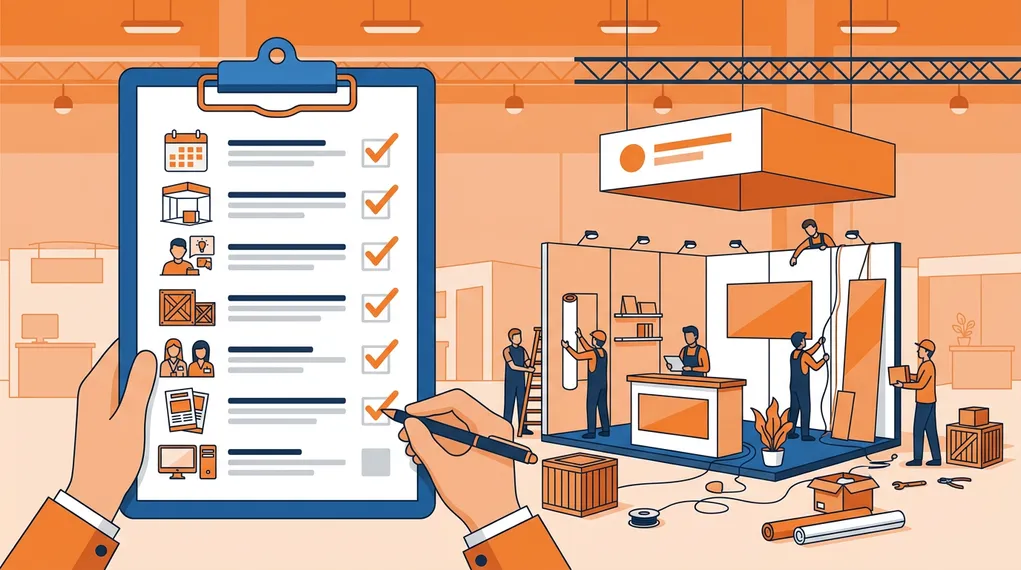
The Four-Phase Framework
A trade show isn’t a single event. It’s a campaign that runs across four distinct phases, each with its own deliverables. Skip a phase, and the ones that follow will underperform.
Phase 1: Strategy (3–2 months before)
Define your goals, audience, and success metrics. Choose which events to attend. Set your budget. Identify target accounts who will be at the show. Build your pre-event outreach list. Book meetings with high-priority prospects before you arrive. Register your team. Reserve your booth location early — corner booths and aisle positions generate 20–30% more foot traffic. Define your event-specific messaging: what problem are you solving for this audience?
Phase 2: Preparation (1 month before)
Brief your booth team on qualifying criteria, pitch framework, and role assignments (greeter, qualifier, demo, lead capture). Set up your lead capture technology — badge scanner, card scanner, voice transcription, CRM integration. Test everything offline. Configure event-specific follow-up instructions so AI drafts match the tone and content of the show. Prepare customer profiles for personalized outreach. Print collateral, order swag, finalize booth design. Run a 15-minute team rehearsal: walk through the capture-to-follow-up workflow end to end.
Phase 3: At the Event
Execute the workflow you rehearsed. For every meaningful conversation: scan the badge, record a 30-second voice note with context, and trigger the AI follow-up before the next prospect walks up. Assign leads to the right rep in real time — don't wait until post-event. Run a 10-minute team debrief at the end of each day: how many leads captured, how many followed up same-day, any qualifying patterns emerging. Keep the booth energy high — rotate staff to avoid fatigue. Track your daily lead count against your target.
Phase 4: Post-Event (first week after)
If you followed up in real time at the booth, your post-event workload is minimal — most leads already received a personalized email. For any remaining leads, follow up within 48 hours. Review CRM data: are all leads synced with full context? Run the team debrief: total leads captured, same-day follow-up rate, response rate, pipeline generated. Calculate cost per lead and compare against your target. Document lessons learned for the next event. Schedule second-touch follow-ups for leads who didn't reply.
Phase 1: Strategy (3–2 Months Before)
This is where most exhibitors lose before they start. They book the booth, book the flights, and skip the strategic work that makes everything else worthwhile.
Define Clear, Measurable Goals
“Generate leads” is not a goal. “Capture 80 qualified leads with conversation context and follow up 100% same-day” is a goal. Your goals should include a target lead count, a target same-day follow-up rate, and a target pipeline value.
Research Target Accounts
The attendee list is usually available from the event organizer weeks in advance. Cross-reference it with your ICP. Identify the 20–30 accounts you most want to meet. Reach out before the event: “We’ll be at booth 412 — I’d love to show you how we’re solving [specific problem]. Can we book 15 minutes?”
Pre-booked meetings convert at 3–5× the rate of cold booth conversations. They’re the highest-ROI activity at any event.
Build Your Budget with Hidden Costs
Booth space and travel are obvious. The hidden costs are what kill ROI: staff time (salary × days at event), opportunity cost (deals not worked while traveling), post-event processing time, and technology that doesn’t deliver. For a complete framework on how to calculate your trade show ROI, see our dedicated guide.
38%
of exhibitor budgets are spent on costs that don't directly generate leads
CEIR Exhibition Spending Report
Choose Events Strategically
Not all events are equal. Compare events by: attendee quality (ICP match), attendee volume, competitor presence, and historical ROI. One high-quality vertical conference can outperform three broad horizontal shows.
Phase 2: Preparation (1 Month Before)
Strategy is complete. Now operationalize it.
Brief the Booth Team
Every person at the booth should know: the target ICP, the qualifying criteria (what makes a lead hot vs. warm vs. cold), the pitch framework (not a script — a structure), and the lead capture workflow.
The biggest preparation mistake is assuming the team knows the workflow. They don’t. Walk through it: scan → record → AI draft → review → send → CRM sync. Do it once as a dry run. If you’re exhibiting in the EU, also brief the team on GDPR requirements for trade show lead capture — especially the consent flow for recording conversations. The rep who fumbles with the app at the booth is the rep who didn’t practice. For a comprehensive guide on how to prepare your sales team for a trade show, see our team preparation playbook.
Set Up Lead Capture Technology
Your lead capture stack should be configured and tested before you arrive:
- Badge/card scanning: test with real badges (or print test cards) to verify OCR accuracy
- Voice transcription: test in a noisy environment — trade show floors are loud
- CRM integration: verify that leads sync with the right fields, tags, and owners
- Offline mode: enable airplane mode and test the full workflow — scan, record, draft, queue for sync. If your venues have unreliable WiFi, read our guide on offline lead capture without WiFi
- Event-specific instructions: configure AI follow-up instructions that match the tone and content of the specific event
- Customer profiles: set up profiles for the verticals you expect to meet
Prepare Collateral and Logistics
This is the checklist most people think of first — and it matters, but it’s downstream of strategy and preparation:
- Booth design, signage, and branding
- Demo hardware and backup devices
- Printed collateral (one-pagers, case studies)
- Charging stations and power strips
- Business cards (yes, still)
- Comfortable shoes (seriously)
Phase 3: At the Event
Execution day. The team is briefed, the tools are tested, the booth is ready.
The Capture Workflow
For every qualified conversation, the workflow is:
- Scan the badge or business card (10 seconds)
- Record a voice note with conversation context (30 seconds)
- AI drafts a personalized follow-up email (automatic)
- Review and send the email from your business address (30 seconds)
- CRM sync happens automatically in the background
Total time: under two minutes. This means the prospect receives a personalized follow-up while they’re still at the event — while your conversation is still fresh. For the complete breakdown of this workflow, see our guide on how to follow up in under two minutes.
Daily Debrief (10 Minutes)
At the end of each day, gather the team:
- Numbers: How many leads captured today? How many followed up same-day?
- Patterns: What questions are prospects asking repeatedly? Any qualifying criteria to adjust?
- Energy: Who’s burned out? Rotate roles for tomorrow.
- Pipeline: Any hot leads that need immediate attention (dinner meeting, demo)?
This 10-minute investment compounds across a multi-day show. Teams that debrief daily capture 20–40% more qualified leads than teams that don’t.
Manage Booth Energy
A four-day trade show is a marathon, not a sprint. Rotate staff every 2–3 hours. Keep water and snacks at the booth. Have a quiet staging area behind the booth for quick breaks. A tired rep gives a worse pitch and forgets to capture context.
Phase 4: Post-Event (First Week After)
If you executed the real-time workflow at the booth, most of your follow-up work is already done. Every lead who received a same-day email is already in your pipeline. The post-event phase is about closing the gaps and measuring results.
Follow Up on Remaining Leads
Any leads that didn’t receive a real-time follow-up (late-day conversations, after-hours events) should be followed up within 48 hours. The window closes fast — response rates drop dramatically after day two.
Verify CRM Data
Check that every captured lead is in your CRM with:
- Full contact information (name, email, company, title)
- Conversation context (voice transcript or notes)
- Qualification tags (hot / warm / cold)
- Follow-up email sent
- Assigned to the right rep
If any of these are missing, you have a process gap to fix before the next event. The quality of your CRM data from events directly determines whether those leads convert.
Run the Numbers
Calculate your event performance:
- Total leads captured vs. target
- Same-day follow-up rate (target: 90%+)
- Response rate on follow-up emails
- Pipeline generated within 30 days
- Cost per lead (total event spend ÷ qualified leads)
Document Lessons Learned
Write a one-page event retrospective: what worked, what didn’t, what to change next time. Share it with the team. The exhibitors who improve fastest are the ones who treat every event as a learning cycle.
The Meta-Checklist: What to Verify at Each Phase
Here’s the compressed version you can print and bring to your next event:
3–2 months before: Goals defined. Budget set. Target accounts identified. Pre-event outreach started. Team registered. Booth location reserved.
1 month before: Team briefed on ICP, qualifying criteria, and workflow. Lead capture technology configured and tested (including offline). Event-specific instructions set. Customer profiles configured. Collateral and logistics confirmed. Dry run completed.
At the event: Capture workflow running (scan → record → AI draft → send → CRM sync). Daily debriefs happening. Staff rotation managed. Daily lead count tracked against target.
First week after: Remaining leads followed up within 48 hours. CRM data verified. Event metrics calculated. Retrospective documented.
The Difference Between Exhibitors Who Prepare and Exhibitors Who Don’t
Unprepared teams capture contacts. Prepared teams capture pipeline. The difference isn’t talent or budget — it’s process. A team with a checklist, a rehearsed workflow, and the right lead capture tools will outperform a team with twice the budget and no plan. For a deeper look at how AI powers each step of this workflow, see our practical guide to AI at trade shows.
The checklist isn’t glamorous. But the exhibitors who follow it don’t come home to a spreadsheet of names and a sinking feeling that they wasted the event. They come home to a CRM full of qualified leads with conversation context, personalized follow-ups already sent, and a pipeline that justifies the investment.
That’s the difference between attending a trade show and winning one.
Frequently Asked Questions
Start 3 months before for strategy and goal-setting, 2 months for logistics and team selection, 1 month for technology setup and rehearsals. The week before should be final briefings and role assignments. Preparation quality directly correlates with lead capture volume — prepared teams capture 3-5× more qualified leads.
At minimum: a lead capture app on every rep's phone, CRM access for real-time sync, and a team communication channel. Advanced setups add conversation recording, AI follow-up drafting, and automated lead scoring. Test everything — especially offline mode — before the event.
Key metrics: leads captured, follow-up rate (target 100%), speed to first follow-up, meetings booked within 30 days, pipeline generated at 90 days, and cost per qualified lead. Track per-rep metrics for coaching.
Day 1 priorities: team debrief to share key learnings, score all leads (hot/warm/cold), assign ownership, verify all data synced to CRM, and confirm all Day 0 follow-ups were sent. Any lead not yet followed up gets a personalized email by end of Day 1.
Scan, record, follow up, and sync — all at the booth. Try NeverDrop free.
Get Started Free