GDPR and Trade Show Lead Capture: A Practical Guide for 2026
· 11 min read
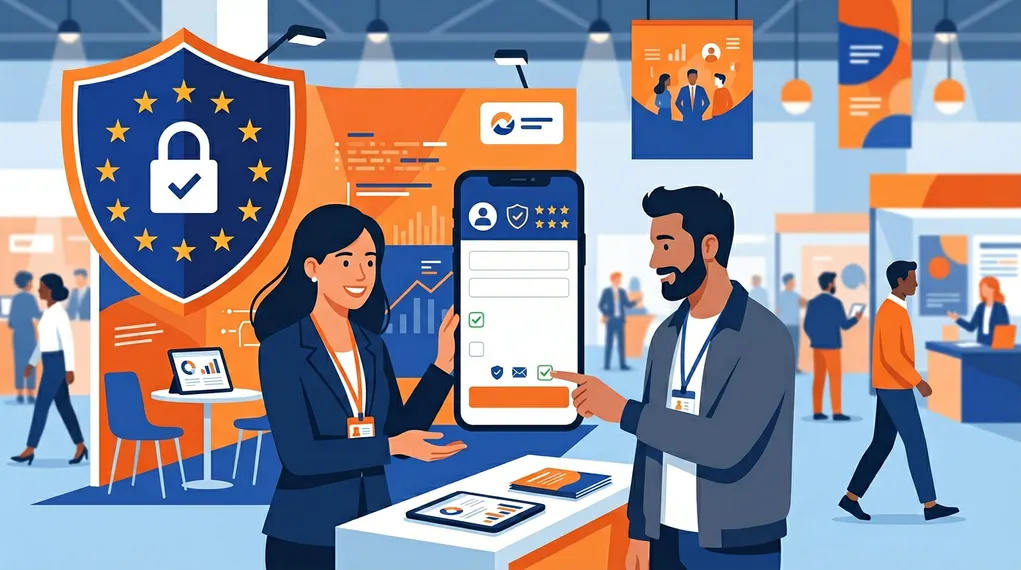
Every time you scan a badge or collect a business card at a European trade show, you’re processing personal data. Under the General Data Protection Regulation (GDPR) — and its UK equivalent, the UK GDPR — that processing must have a legal basis, be transparent to the data subject, and meet strict security and accountability requirements.
Most sales teams know GDPR exists. Far fewer know what it actually requires in the context of event lead capture. The result is a compliance gap: teams either ignore the rules entirely (risky) or overcompensate with clunky consent flows that kill the natural rhythm of a trade show conversation (unnecessary).
This guide covers what you actually need to do — practically, not theoretically — to capture leads at trade shows while staying fully GDPR-compliant.
€4.3B+
in GDPR fines imposed since 2018 across the EU
GDPR Enforcement Tracker
Does GDPR Apply to Trade Show Lead Capture?
Yes. Unambiguously.
GDPR applies whenever you process personal data of individuals in the EU/EEA (or UK), regardless of where your company is based. “Personal data” includes names, email addresses, job titles, company names, phone numbers, photos, conversation recordings, and any notes that relate to an identifiable individual.
Trade show lead capture involves all of the above. Scanning a badge captures personal data. Collecting a business card captures personal data. Recording a conversation captures personal data. Taking notes about a prospect captures personal data. Every one of these actions is “processing” under GDPR.
The fact that it happens at a public event doesn’t create an exemption. The fact that the prospect voluntarily gave you their card doesn’t waive their rights. The fact that “everyone does it this way” isn’t a legal basis.
Legal Bases for Event Lead Capture
Under GDPR, every processing activity needs a legal basis. For trade show lead capture, two are relevant:
Legitimate Interest (Article 6(1)(f))
This is the most commonly used legal basis for B2B event lead capture. The argument: your company has a legitimate interest in following up with prospects who voluntarily engaged with you at a trade show, and this interest isn’t overridden by the prospect’s privacy rights.
Legitimate interest works for:
- Scanning badges or business cards that the prospect voluntarily presented
- Storing contact information for follow-up
- Sending business-relevant follow-up emails after the event
- Enriching contact data from professional databases (see our guide on email enrichment at events for how this works in practice)
Legitimate interest requires:
- A documented Legitimate Interest Assessment (LIA)
- Balancing your interest against the prospect’s rights
- Providing clear notice about what you’re doing with the data
- An easy opt-out mechanism
Important: Legitimate interest is not a blank check. You still need to inform the prospect, limit data collection to what’s necessary, and respect opt-out requests promptly.
Consent (Article 6(1)(a))
Consent is required when legitimate interest doesn’t apply — most notably for recording conversations. Audio recording captures sensitive personal data and goes beyond what a prospect would reasonably expect from a business card exchange. Recording requires explicit, informed, freely given consent.
Consent must be:
- Freely given — The prospect must be able to decline without consequence
- Specific — “I consent to this conversation being recorded for follow-up purposes”
- Informed — The prospect must know what will happen with the recording
- Unambiguous — A clear affirmative action (verbal confirmation, button tap, signature)
Consent must also be revocable — the prospect can withdraw consent at any time, and you must be able to demonstrate when and how consent was obtained.
The Practical Compliance Checklist
Here’s what you need to have in place before your team steps onto the event floor:
1. Privacy Notice
A clear, accessible document that explains:
- Who you are (company name, contact details, DPO if applicable)
- What data you collect at events
- Why you collect it (legal basis)
- How long you keep it
- Who you share it with (CRM, email tools, enrichment services)
- How the prospect can access, correct, or delete their data
This can be a printed card at your booth, a URL on your badge scanner interface, or a QR code that links to your privacy policy. It must be available before or at the moment of data collection.
2. Consent for Recording
If you’re recording conversations (live transcription, voice notes), you need explicit consent before the recording starts. This means:
- Informing the prospect that the conversation will be recorded
- Explaining the purpose (to generate a personalized follow-up)
- Getting a clear verbal or digital confirmation
- Timestamping the consent
3. Data Minimization
Collect only what you need. At a trade show, the relevant data is:
- Contact information (name, company, title, email, phone)
- Conversation content (transcript or notes)
- Event context (which event, which booth interaction)
You do not need and should not collect: personal social media accounts unrelated to business, demographic data irrelevant to the business relationship, or any special category data (health, political opinions, ethnic origin).
4. Data Subject Rights
You must be able to:
- Access: Provide the prospect with all data you hold about them, on request
- Rectification: Correct inaccurate data
- Erasure: Delete their data upon request (“right to be forgotten”)
- Portability: Export their data in a standard format
- Objection: Stop processing their data for direct marketing upon request
Response deadline: 30 days from request.
5. Data Security
Personal data must be stored securely with appropriate technical and organizational measures:
- Encryption in transit and at rest
- Access controls (not every team member needs access to all leads)
- Data processing agreements (DPAs) with all third-party services
- Regular security reviews
The Consent Workflow Challenge
Consent at trade shows is inherently awkward. You’re having a natural business conversation, and at some point you need to say: “Before I record this, I need your consent.” Done badly, it kills the conversation flow. Done well, it’s a 10-second non-event.
The key is making consent part of the workflow, not an interruption:
Start the conversation naturally
Introduce yourself, learn about the prospect, exchange cards. No consent is needed yet — you're collecting business card data under legitimate interest.
Before recording, ask for consent
When you want to start recording (live transcription or voice note), explain briefly: 'I'd like to capture our conversation so I can send you a relevant follow-up. Is that okay?' Most professionals say yes — it signals professionalism and attention.
Capture the consent digitally
The prospect confirms (verbally or with a tap). The timestamp is recorded automatically. This creates an auditable consent trail linked to the specific lead record.
Continue the conversation
The consent step takes 5–10 seconds. The conversation resumes naturally. The recording captures the context that will power a personalized follow-up.
Respect withdrawal
If the prospect declines or later requests deletion, the recording is immediately discarded. No recording means the follow-up uses only the business card data (still valid under legitimate interest).
NeverDrop builds this workflow directly into the app: a consent confirmation step appears before any recording begins, with a timestamp stored in the lead record. This creates the audit trail GDPR requires, without adding friction to the conversation.
EU-Hosted vs US-Hosted Tools
Data residency matters under GDPR. While the EU-US Data Privacy Framework (DPF) allows certain US companies to receive EU personal data, the legal landscape has been unstable — Privacy Shield was invalidated in 2020 (Schrems II), and the DPF may face similar challenges.
For teams that want to minimize regulatory risk, EU-hosted tools provide the simplest compliance posture:
| US-hosted tools | EU-hosted tools | |
|---|---|---|
| Data residency | US servers (with or without DPF certification) | EU servers (no cross-border transfer) |
| Transfer mechanism | Requires DPF, SCCs, or BCRs | No transfer mechanism needed |
| Schrems II risk | Ongoing legal uncertainty | Not applicable |
| DPA complexity | Higher (multi-jurisdiction) | Lower (single jurisdiction) |
| Regulatory simplicity | Requires ongoing monitoring | Straightforward |
| Prospect confidence | Variable (privacy-conscious prospects may object) | High (data stays in EU) |
NeverDrop hosts all data in the EU (Supabase EU region), with no data transfer to US servers. This eliminates the cross-border transfer compliance burden entirely. NeverDrop also works fully offline without WiFi, with data stored locally on the device until connectivity returns — meaning data never transits through uncontrolled networks. To see how NeverDrop’s compliance posture compares to other tools, visit our comparison page.
Common Mistakes
“They gave me their card, so I have consent.” Handing over a business card is not consent under GDPR. It may support a legitimate interest basis, but it doesn’t satisfy the consent requirements for recording or marketing communications.
“It’s a B2B event, GDPR doesn’t apply to businesses.” GDPR protects natural persons, not businesses. The business card belongs to a person. The email address belongs to a person. The conversation was with a person. GDPR applies.
“We’ll deal with GDPR after the event.” GDPR compliance must be in place at the moment of data collection, not retroactively. You can’t add a legal basis after the fact.
“Our badge scanner provider handles GDPR.” Your badge scanner is a data processor. You are the data controller. The legal responsibility sits with you. Having a DPA with your scanner provider is necessary but not sufficient.
“Recording is fine because the conversation happened in public.” A trade show booth is not a public space for GDPR purposes. Even if it were, recording a conversation in a public space still requires a legal basis and transparency.
Practical Tips for Sales Teams
Brief your team before every event. A 15-minute pre-event briefing on data handling procedures prevents compliance incidents. Cover: when to ask for recording consent, how to handle deletion requests, where data is stored.
Use tools with built-in compliance features. The easier you make compliance, the more consistently your team will follow the process. Choose lead capture tools that integrate consent workflows into the capture flow rather than requiring manual documentation.
Keep records of consent. GDPR requires you to demonstrate compliance. Timestamped digital consent records are far more reliable than “I think they said yes” recollections.
Have a data deletion process ready. When a prospect requests deletion (and they will), your team should know exactly how to execute it — and be able to do it within the 30-day deadline. This is much easier with a centralized tool than with scattered spreadsheets and email exports.
Audit your event tech stack. Every tool that touches prospect data needs a DPA: your badge scanner, your CRM, your email sender, your enrichment provider, your transcription service, your cloud storage. Map the data flow before the event and ensure every link in the chain is covered.
For a comprehensive overview of event lead capture workflows that incorporates these compliance requirements, see our complete guide to event lead capture.
GDPR as a Trust Signal
Here’s the counterintuitive truth: GDPR compliance isn’t just a legal obligation — it’s a competitive advantage. In 2026, privacy-aware prospects actively evaluate how vendors handle their data. Being transparent about your data practices signals professionalism and builds trust.
When a salesperson says, “I’d like to record our conversation so I can send you a relevant follow-up — is that okay?”, the prospect hears: “This person takes their job seriously and respects my data.” It’s a differentiator in an era where most vendors treat personal data as something to be extracted, not protected.
The teams that treat GDPR as an opportunity rather than a burden will build stronger prospect relationships — and that starts at the trade show booth.
Frequently Asked Questions
Yes, when done correctly. Scanning a business card given to you at a professional event falls under 'legitimate interest' — you have a reasonable basis to process the data for follow-up. However, you must provide a privacy notice, honor data subject requests, and store data securely in an EU-hosted system.
In most EU countries, yes. NeverDrop includes a consent acknowledgment flow before recording starts. The safest approach is to verbally inform the prospect that you're recording notes for follow-up purposes and get their verbal confirmation before starting.
The most common basis under GDPR is legitimate interest (Article 6(1)(f)). When someone hands you a business card at a professional event, there is a reasonable expectation of follow-up. Consent (Article 6(1)(a)) is required for recording conversations and marketing communications.
EU-hosted infrastructure is strongly recommended. NeverDrop stores all data in EU data centers. US-hosted tools require additional safeguards (Standard Contractual Clauses) and carry higher compliance risk after the Schrems II ruling.
GDPR-compliant lead capture with built-in consent workflows. Try NeverDrop — EU-hosted, privacy-first.
Get Started Free