NeverDrop vs Convention Center Badge Scanners: Why Renting Is Dead
· 8 min read
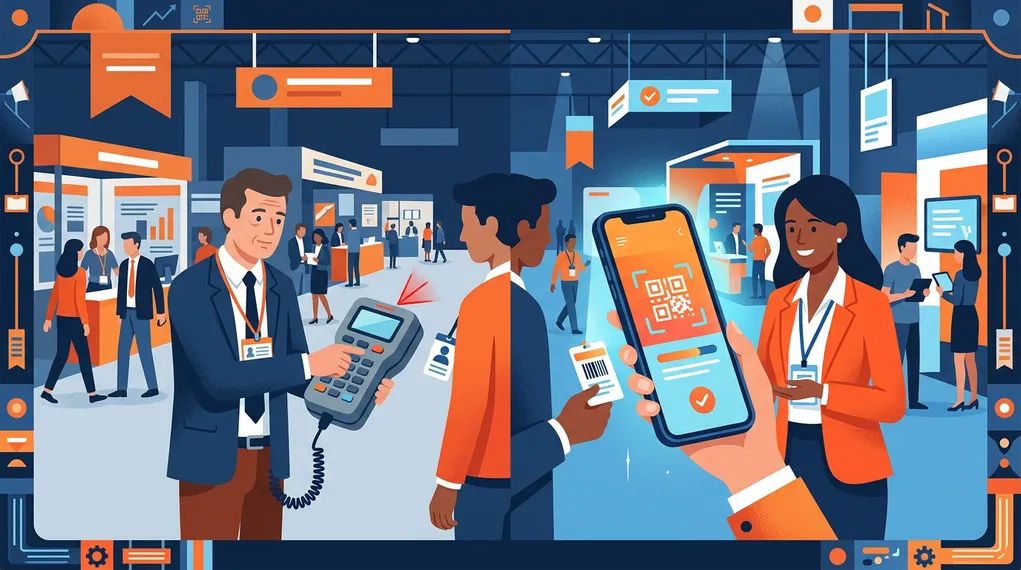
Every year, thousands of exhibitors walk up to a convention center’s registration desk and rent a badge scanner. The device costs $300 to $575 per unit, works only at that specific venue, and captures exactly two fields: name and email. At the end of the show, you return the scanner, download a CSV, and hope someone on your team remembers who was worth following up.
This has been the standard for two decades. It’s also wildly outdated.
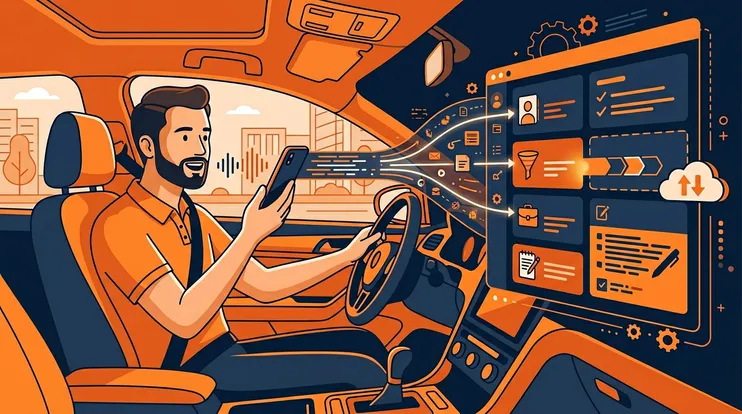
The badge scanner rental model was built for an era when mobile phones couldn’t scan barcodes and cloud apps didn’t exist. Today, the device in your pocket is more powerful than anything the convention center will hand you — and the software running on it can do orders of magnitude more than read a QR code.
This article breaks down exactly why renting badge scanners is a losing proposition, and what the modern alternative looks like.
The True Cost of Renting Badge Scanners
The sticker price — $300 to $575 per device — is just the start. Here’s what badge scanner rental actually costs when you factor in the full picture.
Per-Event, Per-Device Pricing
Every event is a new rental. If your team attends 10 trade shows a year and needs 3 scanners each time, you’re spending $9,000 to $17,250 annually on hardware that does less than a free app on your phone. There’s no volume discount because each convention center runs its own rental operation. When you factor in the leads you lose due to delayed follow-up, the true cost is even higher — see our trade show ROI calculator for the full math.
Zero Portability
The scanner you rent at CES doesn’t work at HIMSS. The one you rent at Hannover Messe doesn’t work at Web Summit. Each venue uses its own badge format, its own registration platform, and its own proprietary scanning hardware. You’re paying full price every single time because nothing carries over.
Minimal Data Capture
Most rented badge scanners read the barcode or QR code printed on the attendee’s badge. What comes back is whatever the event organizer encoded: typically a name, company, and email. No phone number. No title. No conversation context. No notes. Just a row in a spreadsheet.
2 fields
is the typical data captured by a rented badge scanner — name and email
ExhibitorOnline — Lead Retrieval Technology Survey
No Intelligence, No Follow-Up
A badge scanner is a dumb reader. It reads a code. That’s it. There’s no AI enrichment, no conversation transcription, no follow-up drafting, no CRM sync. Your team walks away from a three-day event with a CSV file and zero context about who was hot, who was cold, and what anyone actually talked about.
Data Delay
Many rental systems don’t provide real-time access to scanned data. You get your leads after the event — sometimes 24 to 48 hours later. By then, the prospect has visited 30 other booths and forgotten your conversation.
What Modern Lead Capture Actually Looks Like
The shift from hardware to software isn’t just a technology upgrade — it’s a category change. Badge scanner rental is a logistics service. Modern lead capture apps are field sales intelligence platforms.
Here’s the difference in practice.
Capture Goes Beyond Barcodes
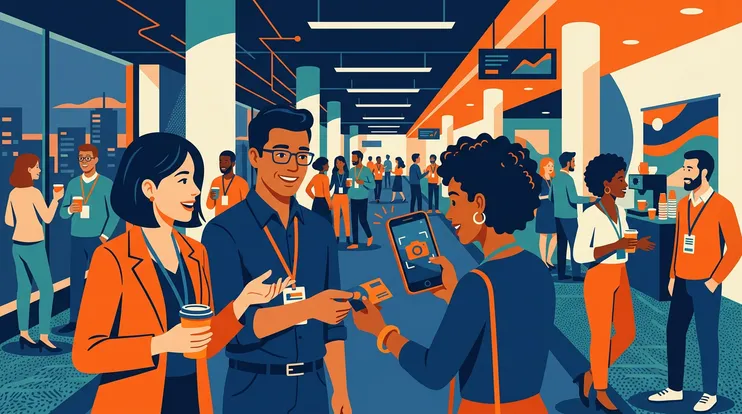
A badge scanner reads one code format at one venue. An app like NeverDrop scans badges, business cards, QR codes, and NFC tags — at any event, anywhere in the world. When the badge format is proprietary, you scan the card instead. When there’s no badge at all, you enter contact details manually or scan a LinkedIn QR. The entry point is flexible, not locked to one venue’s system.
Context Replaces Data Entry
The biggest problem with badge scanning isn’t the scan itself — it’s everything that doesn’t happen after it. When a rep scans a badge, they get a name. But what did they talk about? What was the prospect’s pain point? Were they a decision-maker or an intern?
With conversation transcription, the app records and transcribes the actual booth conversation in real time. Speaker identification separates your rep’s voice from the prospect’s. The transcript becomes the context that drives everything downstream: qualification, follow-up, CRM notes.
AI Does the Follow-Up
After a long event day, your reps are exhausted. Writing 40 personalized follow-up emails is the last thing they want to do — and it’s the single most important activity for event ROI. 80% of trade show leads receive no follow-up at all, not because reps don’t care, but because the manual effort is too high.
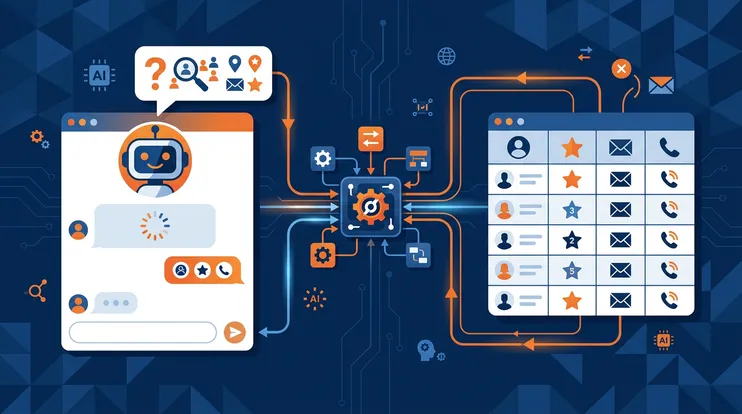
AI-drafted follow-ups change this completely. The app reads the conversation transcript, the contact data, the customer profile, and the rep’s instructions — then drafts a personalized email that references what was actually discussed. The rep reviews, tweaks if needed, and sends. What used to take 15 minutes per lead takes 30 seconds.
CRM Sync Happens Automatically
Badge scanner data lives in a CSV. Someone has to download it, clean it, deduplicate it, and import it into the CRM. This step happens days after the event — if it happens at all.
With native CRM integration, leads flow directly from the field to HubSpot (or Salesforce, or Pipedrive). Contacts, companies, deals, and owners are created or updated automatically. No export file, no manual import, no data hygiene nightmare.
Offline Mode Is Non-Negotiable
Here’s the irony of rented badge scanners: they often work offline because they’re reading local barcodes. But the moment you upgrade to software, most apps assume you have WiFi. Convention halls with 10,000 attendees routinely saturate their network. If your app can’t work offline, it’s less reliable than the hardware it replaced.
NeverDrop was built offline-first. Scanning, transcription, notes, and even AI follow-up queuing work without connectivity. Everything syncs when you’re back online. This isn’t a workaround — it’s a core design principle.
Head-to-Head: Badge Scanner Rental vs NeverDrop
| Capability | Badge Scanner Rental | NeverDrop |
|---|---|---|
| Cost model | $300–575 per device per event | Pay-per-use — free to start |
| Data captured | Name + email (barcode only) | Full contact + conversation + notes |
| Conversation context | ✗ | ✓ — live transcription with speaker ID |
| AI follow-up emails | ✗ | ✓ — drafted from real conversation |
| CRM sync | ✗ — CSV export only | ✓ — native HubSpot sync |
| Offline mode | ✓ (barcode only) | ✓ (full pipeline: scan, transcribe, queue) |
| Multi-event portability | ✗ — venue-locked | ✓ — works at any event worldwide |
| Contact enrichment | ✗ | ✓ — email and phone enrichment |
| GDPR compliance | Varies by venue | ✓ — EU-hosted data |
| Team workspace | ✗ | ✓ — shared leads with assignment |
The comparison isn’t close. Badge scanner rental gives you two data fields and a CSV. A modern app gives you a full pipeline from scan to CRM.
The Real Problem: Lead Decay
The fundamental issue with badge scanner rental isn’t the hardware — it’s the time gap it creates. You scan a badge on Tuesday. You get the CSV on Wednesday or Thursday. Someone cleans the data on Friday. The CRM import happens Monday. The first follow-up goes out Tuesday — a full week after the conversation.
By then, the prospect has been contacted by 10 other exhibitors. They don’t remember your booth. Your follow-up is generic because nobody remembers the conversation either. The lead is cold.
80%
of trade show leads receive no follow-up within the first week
CEIR — Center for Exhibition Industry Research
Same-day follow-up changes the math entirely. When a rep can send a personalized email within hours of the conversation — referencing what was discussed, the prospect’s specific challenges, and a concrete next step — response rates increase dramatically.
This isn’t possible with a badge scanner. It’s the default workflow with NeverDrop. For the complete capture-to-CRM pipeline that replaces badge scanner CSV exports, see our complete guide to event lead capture.
Who Still Needs Badge Scanner Rental?
To be fair, there are scenarios where renting makes sense:
Large booth operations with 20+ staff who need identical, zero-training hardware. If your priority is maximum throughput (scan as many badges as possible with no conversation capture), a rented scanner is simple and reliable.
Events where the organizer requires official lead retrieval and the badge format isn’t scannable by third-party apps. Some event platforms encrypt badge data and only their rental devices can decode it.
For everyone else — small and mid-market exhibitors, field sales teams, companies attending multiple events per year — the rental model is an expensive way to collect less data with no intelligence attached.
The Shift From Hardware to Software
The trade show industry is following the same pattern as every other industry: purpose-built hardware is being replaced by software running on general-purpose devices. Just as GPS devices were replaced by phone apps, and point-of-sale terminals were replaced by tablet-based systems, badge scanner rentals are being replaced by mobile lead capture platforms.
The winners of this shift are the exhibitors who recognize that lead capture isn’t about scanning barcodes. It’s about capturing the full context of a sales conversation and acting on it before the lead goes cold.
If you’re still renting badge scanners, you’re paying a premium for the least capable option in the market. The alternative isn’t theoretical — it’s available today, works offline, and costs a fraction of what you’re currently spending.
For a broader comparison of lead capture tools, see our honest comparison of the best trade show lead capture apps. For a look at how NeverDrop compares to a full event engagement platform, see our NeverDrop vs Momencio analysis. Or explore all NeverDrop features and pricing directly.
Stop paying $500 per scanner for a CSV with two columns. Capture leads, conversations, and context — for free.
Try NeverDrop Free