How to Never Lose a Lead at an Event: The Complete Guide
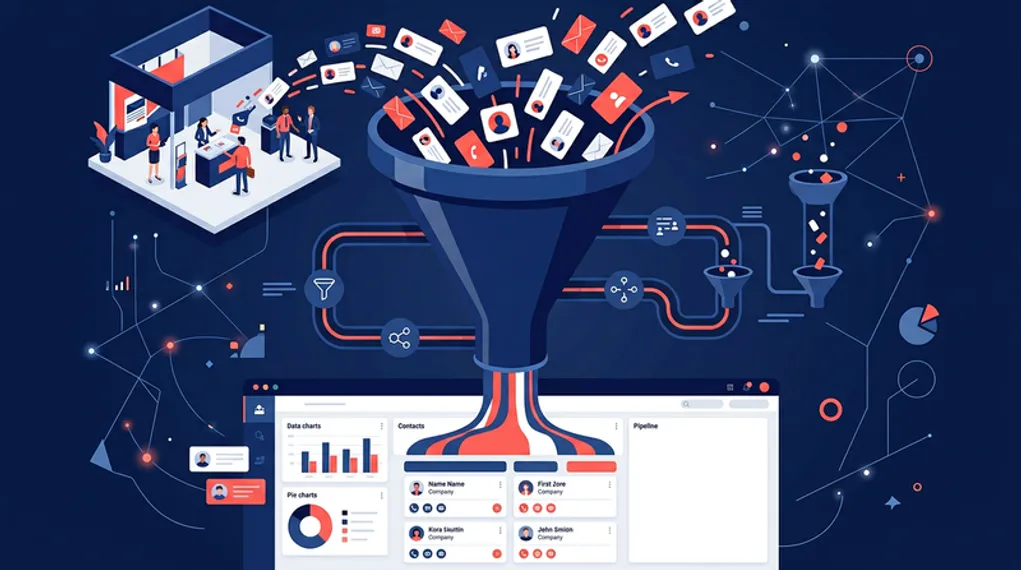
Here’s a number that should make every sales leader uncomfortable:
80% of trade show leads never receive any follow-up at all.
Not “get followed up late.” Not “receive a generic email.” No follow-up, period.
Your team spent $20,000 on a booth, flew across the country, had dozens of great conversations — and four out of five contacts never heard from you again.
This isn’t a people problem. It’s a systems problem. And it’s fixable.
Where Exactly Do Leads Get Lost?
Lead loss doesn’t happen in one dramatic moment. It’s death by a thousand cuts — small failures that compound across every stage of the event.
During the Event
You’re mid-conversation at the booth. Someone asks a question, a colleague taps your shoulder, the next prospect walks up. You slip the business card into your pocket and tell yourself you’ll add notes later.
You won’t. Without immediate capture, memory degrades by 50–80% within 24 hours — and at a trade show, you’re having dozens of similar conversations per day.
Meanwhile, cards accumulate in badge holders, jacket pockets, and hotel nightstands. Some get crumpled. Some get mixed with receipts. Some get left behind entirely. And even when cards survive physically, the context dies. By end of day, 40 cards look identical — name, title, company — with zero information about what you actually discussed.
Between Event and Office
80% of follow-up delays come from administrative friction, not lack of motivation. Scanning cards, typing data, enriching emails, writing personalized follow-ups, routing leads to the right rep — this processing takes hours, and by then you’ve lost the speed advantage.
Making it worse: in 42% of organizations, there’s no clear ownership. Marketing thinks sales will follow up. Sales thinks marketing will nurture. The lead sits in a CSV file that nobody opens.
After the Event
Leads get dumped into a spreadsheet or a bulk CRM import. Without qualification notes, all 200 contacts look the same — the team can’t tell who was genuinely interested and who just wanted a free pen. (73% of trade show contacts exchange info for giveaways, not because they’re buyers.)
When follow-up finally happens, it’s a mass email that gets deleted because it proves nothing about the actual conversation. Personalized follow-ups improve response rates by 26%, but personalization requires context that was never captured.
The Minute-by-Minute System
The fix isn’t working harder after the event. It’s changing what happens during it. Here’s the exact workflow.
Minute 0–10: The Conversation
Focus entirely on the prospect. Listen actively. Don’t try to take notes while talking — it splits your attention and reduces the quality of both the conversation and the notes.
Mentally flag four things:
- What problem are they trying to solve?
- What did they ask about specifically?
- Is there a timeline or urgency?
- Did you promise to send them something?
Minute 10–11: The Scan
Conversation ends, you shake hands. Before the next person walks up, pull out your phone and scan the business card. AI-powered OCR extracts all contact fields in seconds.
Don’t pocket the card. The moment it goes into your badge holder, it joins the pile — and the pile is where leads go to die. (For more on this, see our guide on scanning business cards efficiently.)
Minute 11–12: The Voice Note
With the conversation fresh — literally seconds after — record a 30-second voice memo:
“Met [name] from [company]. They’re looking at [problem]. We talked about [solution/feature]. They asked me to send [resource]. Timeline is [timeframe]. Seems [hot/warm/cold].”
That’s it. Thirty seconds. Voice is 3× faster than typing and retains details that written notes miss.
Minute 12–14: The Follow-Up Draft
Your scanned data plus voice context feed into an AI-drafted follow-up email that references the actual conversation. Review it, tweak one line if needed, send or schedule for the next morning. (Need templates? We wrote a whole guide on trade show follow-up emails.)
Total time since the handshake: under 4 minutes. Lead captured, contextualized, enriched, follow-up queued. Next conversation.
The Team Playbook
If you’re sending 3–5 reps to a show, individual efficiency isn’t enough. You need team-level systems.
Without clear assignment, things break fast. Two reps scan the same person. One collects 60 cards, another collects 10. The manager has no idea who talked to whom. 60% of companies report that misrouted leads cost them deals every quarter.
The fix: a shared event workspace. Every rep scans into the same place. Each lead is automatically assigned to the rep who scanned it — because they’re the one who had the conversation. This gives you deduplication, manager visibility, balanced workload, and accountability.
End-of-day sync (10 minutes): Before leaving the venue, the team reviews the day’s leads together. Flag high-priority prospects. Reassign leads by territory or product line. Identify missed opportunities to revisit tomorrow.
What People Used Before (And Why It Didn’t Work)
| Method | Where It Breaks |
|---|---|
| Physical cards | Lost, crumpled, no context, hours of manual entry |
| Handwritten notes | Illegible, incomplete, not linked to contact data |
| Camera roll photos | Mixed with personal photos, no extraction, no follow-up path |
| Badge scanners | Basic data only, no context, CSV arrives days later |
| CRM mobile app | Slow data entry at booth, kills conversation flow |
| Spreadsheets | No real-time visibility, no enrichment, post-show only |
| Notes app | Disconnected from contact data, no team sharing |
Every one of these breaks somewhere in the pipeline — they either fail to capture the data, the context, or the follow-up. For a deeper dive, check our guide to managing leads after a trade show.
The ROI of Not Losing Leads
Take a typical mid-market B2B company attending 4 events per year:
| Old Way | With a System | |
|---|---|---|
| Leads collected per event | 100 | 100 |
| Leads with follow-up | 20 (20%) | 95 (95%) |
| Leads with personalized follow-up | 5 (5%) | 90 (90%) |
| Meetings booked | 2 | 20+ |
| Annual qualified pipeline | ~$50K | ~$500K+ |
At $10,000–$30,000 per booth, the difference between 2 meetings and 20 per event isn’t incremental — it’s the difference between trade shows being a cost center and a revenue engine.
78% of deals go to the first company to respond. Companies responding within one hour are 7× more likely to qualify the lead. The math is simple: speed wins.
Build the System, Not the Habit
You can’t solve this with motivation. Sales reps at trade shows are busy, tired, and doing their best. The traditional process — collect cards, type data, write emails, update CRM — has too many manual steps, and each one is a point of failure.
NeverDrop replaces that entire chain with one flow: scan the card, record voice context, get an AI-drafted follow-up, and push to your CRM — all before the next prospect walks up.
Your team shares one workspace per event. Every lead has an owner. Every conversation is captured. Every follow-up is personalized — not because your reps have superhuman memory, but because the system does.
“NeverDrop a lead” shouldn’t be an aspiration. It should be the default.